Author : Nha Tran
Founder & CEO of Varmeta
How generative AI is revolutionizing the business landscape
Generative AI (GenAI) is dramatically reshaping the way businesses operate, creating new opportunities and driving significant changes across industries. The introduction of models like ChatGPT has sparked a surge of interest and investment in AI technologies. Big companies have poured vast amounts of resources into developing their own AI models, recognizing the competitive advantage this technology offers. Generative AI has the potential to increase efficiency, optimize operations, and even create entirely new business models. However, adopting AI is no longer optional, it is an urgent priority for businesses aiming to stay competitive in today’s fast-evolving market.
Source : McKinsey
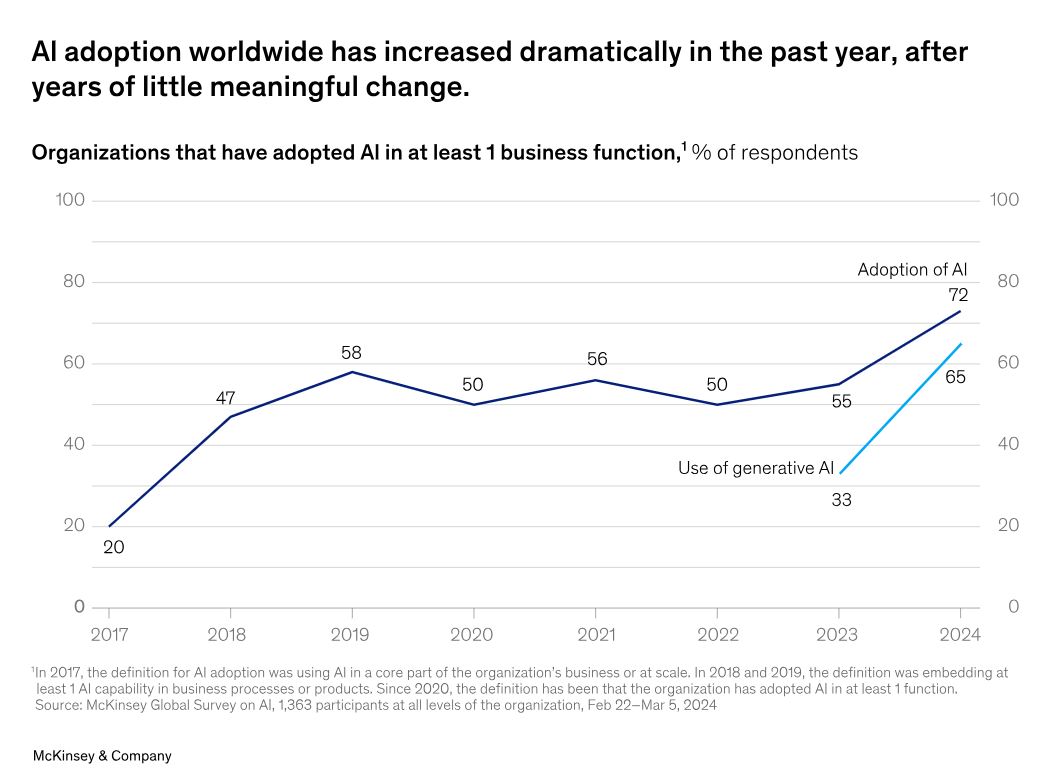
A recent survey by McKinsey highlights this urgency. It found that 65% of organizations are now regularly using generative AI in at least one business function, nearly double the figure from just ten months earlier. Despite this rapid adoption, many businesses struggle with implementation. While most recognize the power of AI, many lack a clear framework for integrating it into their operations. Too often, adoption is limited to encouraging employees to use tools like ChatGPT or Gemini, without a structured approach.
Where generative AI creates the most value ?
Source : McKinsey
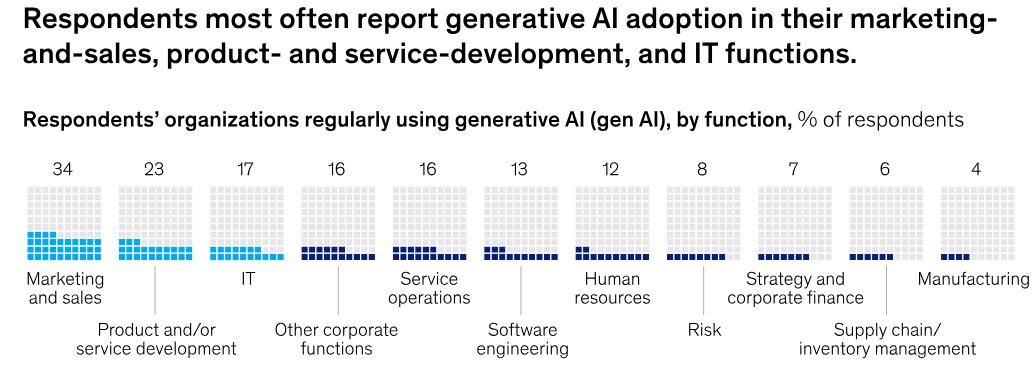
Generative AI adoption is most prevalent in areas where it can deliver the greatest impact. According to the McKinsey survey, organizations primarily use GenAI in marketing and sales, as well as product and service development. These functions benefit from AI’s ability to:
- Enhance customer engagement: By personalizing interactions and offering tailored recommendations, AI transforms how businesses connect with their audiences.
- Optimize product development: Generative AI accelerates innovation by streamlining processes like prototyping and market analysis.
- Drive operational efficiency: By automating routine tasks and improving data analysis, AI helps businesses focus on strategic initiatives.
The average organization uses GenAI across at least two business functions, demonstrating its broad applicability and potential to drive value. Beyond these core areas, AI is finding applications in finance, human resources, supply chain management, and customer support, making it a versatile tool for organizations of all sizes.
In marketing, for instance, generative AI can analyze customer behavior to create hyper-personalized campaigns. This capability not only increases engagement but also improves return on investment. Similarly, in supply chain management, AI-powered tools predict demand trends, optimize inventory, and enhance logistical efficiency, reducing operational bottlenecks.
Understanding what AI can do
To fully leverage the potential of Generative AI (GenAI), businesses must first grasp its capabilities. AI excels in tasks that involve processing vast amounts of data, automating repetitive operations, and enhancing decision-making accuracy. Companies that strategically implement AI experience cost reductions and revenue growth across multiple business functions.
Below are the key areas where AI is making a significant impact:
- Data analysis & predictive insights
AI significantly enhances data processing capabilities, enabling businesses to extract meaningful insights in real-time. AI-driven analytics help companies:
- Detects patterns and trends in consumer behavior and operational data.
- Automate reporting and anomaly detection, reducing human error.
- Enhance strategic planning by predicting market shifts.
- Automation & workflow optimization
AI-powered automation helps companies streamline operations, reducing manual workload and operational costs. AI can:
- Automate administrative tasks such as scheduling, invoicing, and reporting.
- Improve IT system management, including security threat detection.
- Optimize supply chain logistics, minimizing delays and inefficiencies.
- Decision support & risk management
Businesses utilize AI for risk detection and smarter decision-making:
- Analyze financial risks and detect fraudulent activities in real time.
- Provide data-driven recommendations for investments, budgeting, and business expansion.
- Improve compliance monitoring, reducing legal and regulatory risks.
- AI-generated content & marketing personalization
AI has transformed content creation and marketing strategies by:
- Generating personalized campaigns based on consumer data.
- Automating ad targeting and optimization, increasing engagement rates.
- Enhancing customer segmentation, leading to higher conversion rates.
- Workforce development & training
AI-driven learning platforms personalize employee training by:
- Assessing skill gaps and recommending tailored training programs.
- Automating onboarding processes, reducing training costs.
- Enhancing remote learning experiences with AI-driven coaching tools.
- Customer experience enhancement
AI elevates customer interactions by:
- Powering AI-driven chatbots, providing 24/7 instant support.
- Improving service personalization, increasing customer retention.
- Reducing response time by automating FAQs and ticket management.
- Business strategy & predictive analytics
AI strengthens business strategies through:
- Market forecasting, enabling proactive decision-making.
- Financial projections, assisting in budget planning.
- Operational efficiency improvements, optimizing resource allocation.
AI’s impact on cost reduction and revenue growth (2023 data insights)
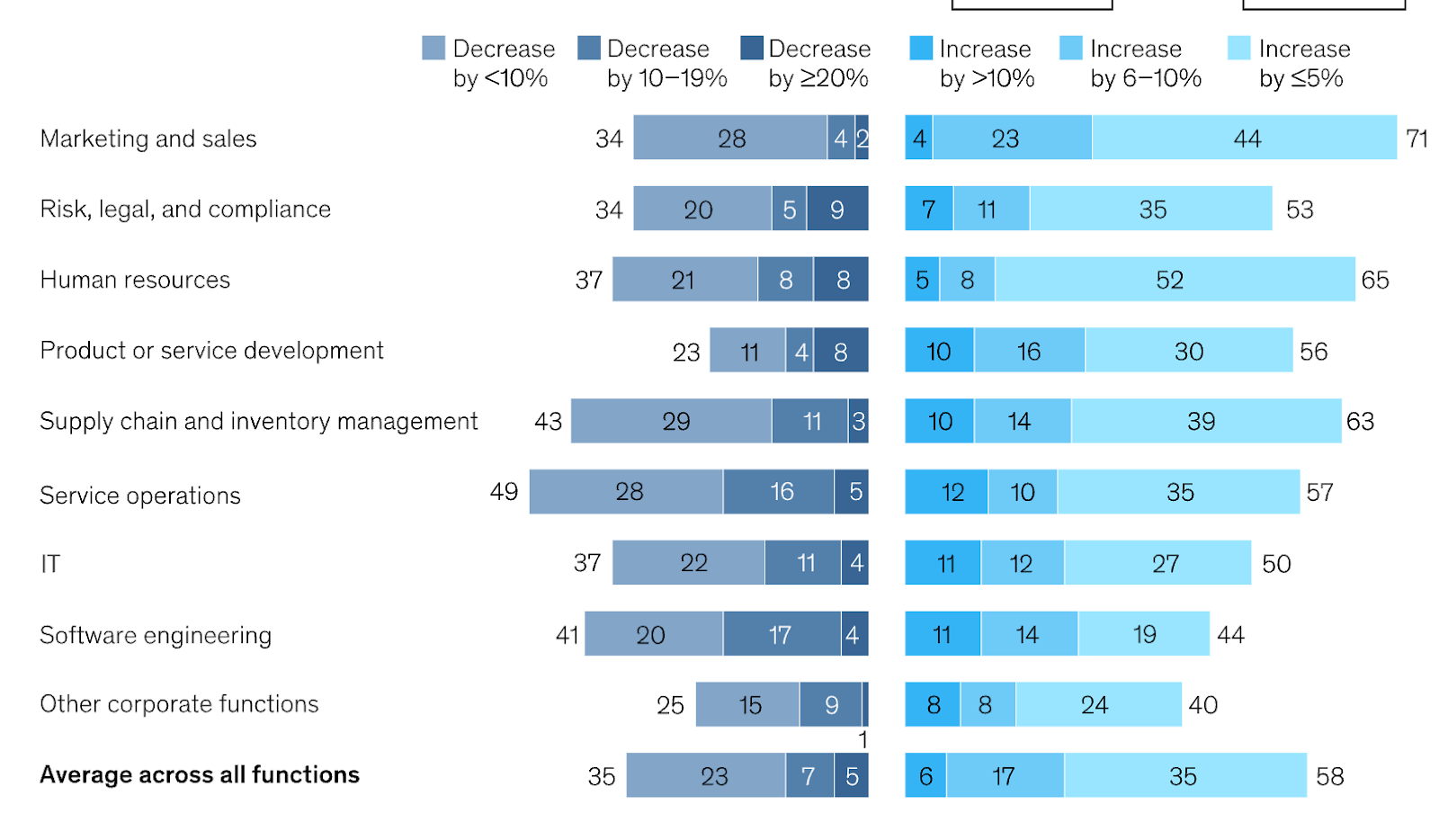
(Cost decrease and revenue increase from analytical AI adoption in 2023, by function) – Source : McKinsey
A recent analysis of AI adoption in business functions (as shown in the provided chart) highlights the financial impact AI has on different sectors.
The impact of AI on businesses is undeniable, driving cost efficiency and revenue expansion across industries. Companies that leverage AI for automation, predictive analytics, and enhanced customer experiences are achieving greater operational agility and competitive advantage. However, successful AI implementation requires strategic planning and continuous monitoring to mitigate risks and maximize returns.
Identifying low-hanging fruit use cases
To get started with AI, leaders should focus on identifying “low-hanging fruit”—areas where AI can deliver quick wins. These use cases often require minimal effort to implement but yield substantial benefits. Key areas to explore include:
- Customer service: Use AI chatbots to handle common queries, reducing wait times and improving customer satisfaction.
- Sales and marketing: Automate lead generation, personalize campaigns, and analyze market trends to drive better results.
- Product development: Leverage AI for market research, prototype creation, and feature optimization.
- Risk and compliance: Automate compliance checks and risk assessments to enhance accuracy and reduce costs.
- HR and recruitment: Streamline the hiring process by using AI to screen resumes and identify top candidates.
- Inventory management: Use AI to predict demand and optimize inventory levels, reducing waste and improving supply chain efficiency.
- Financial analysis: Automate routine accounting tasks, analyze financial data for insights, and ensure regulatory compliance.
To identify these opportunities, leaders should ask:
- Does this job involve processing large amounts of data?
e.g., analyzing reports, identifying patterns, making predictions. Ai will definitely can help free up your employee with these tasks
- Are there repetitive tasks within this job that could be automated?
(e.g., data entry, scheduling, customer service inquiries)
- Can AI assist in making more informed decisions?
AI can analyze data to provide valuable insights and support better decision-making.
- What aspects of this job require uniquely human skills like creativity, critical thinking, emotional intelligence, and complex communication?
AI excels at tasks that can be defined by rules and data, but human skills remain crucial.
- Could AI introduce bias or fairness issues into this job function?
It’s crucial to consider the ethical implications of AI implementation and ensure fairness and equity.
Moreover, organizations should evaluate these use cases through a cost-benefit lens. For example, automating a high-volume customer service function can quickly offset implementation costs, while improving customer satisfaction.
A phased approach to implementing generative AI
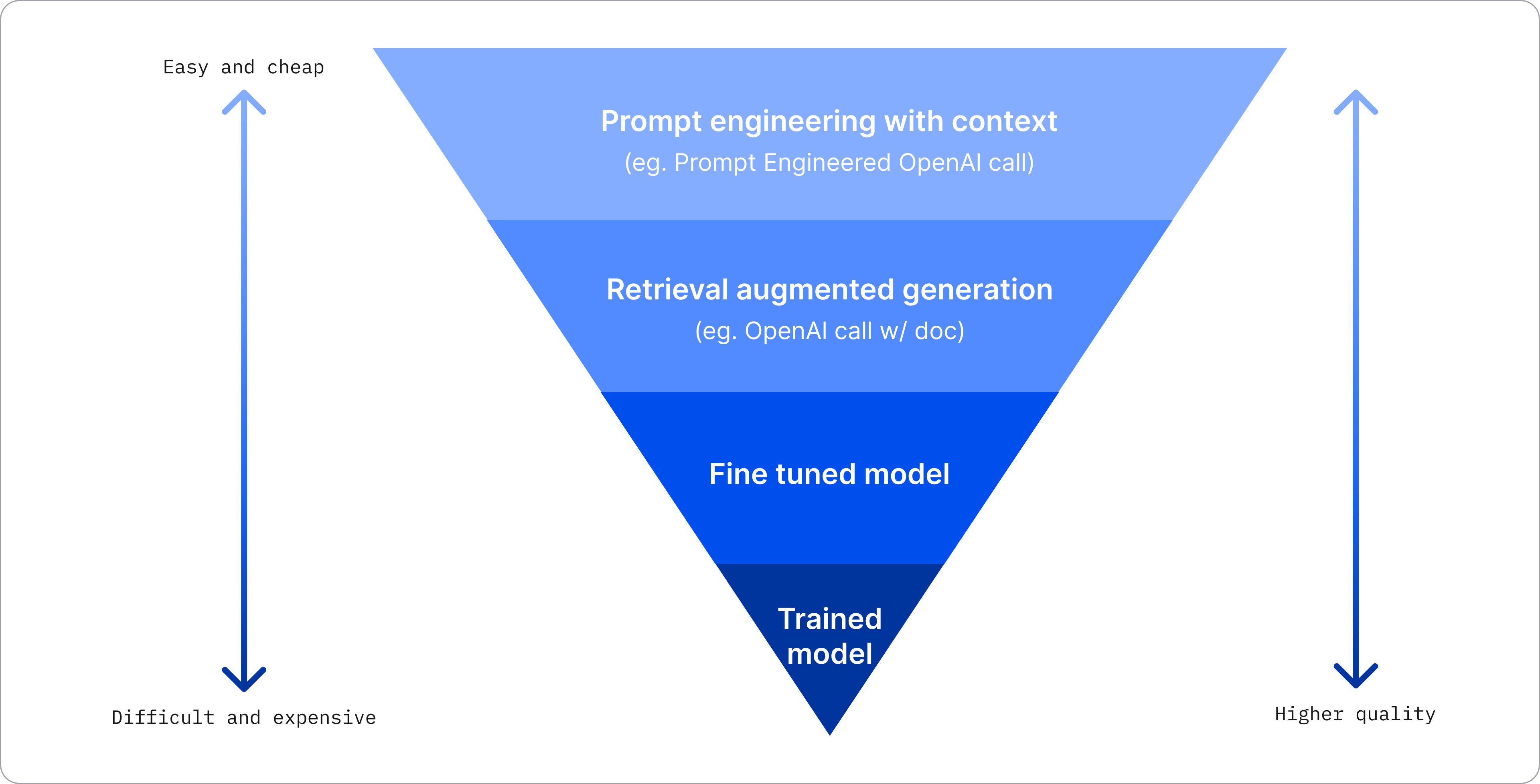
Implementing AI requires a structured, phased approach to ensure success and minimize risks. Companies should start with foundational techniques and gradually progress to more advanced methods:
- Prompt engineering: Begin by mastering the art of crafting effective prompts. Clear and well-structured prompts maximize the quality of AI outputs and ensure relevance. This step is particularly important for teams new to AI, as it sets the foundation for effective use.
- Retrieval augmented generation (RAG): Integrate RAG systems to allow AI to access relevant information from both internal databases and external sources. This enhances the model’s accuracy and reliability, making it a more valuable tool for decision-making and operational tasks.
- Agent development: Develop AI agents capable of autonomously performing tasks, interacting with other systems, and learning over time. These agents can handle complex workflows, reducing manual effort and increasing productivity.
- Fine-tuning: Customize pre-trained AI models using company-specific data to optimize performance for specialized tasks. Fine-tuning enhances the model’s relevance and value, making it a more effective tool for addressing unique business challenges.
- Large Language Model (LLM) training: For advanced use cases, consider training custom LLMs. While this requires significant resources, it offers unparalleled flexibility and precision, enabling businesses to address highly specialized needs.
- Continuous monitoring and iteration: AI implementation is not a one-time effort. Regularly monitor performance, gather feedback, and refine models to ensure they remain effective and aligned with business goals.
Each phase builds on the previous one, ensuring a controlled rollout that minimizes disruption and maximizes returns.
Driving adoption within the team alongside the progress
Even the best AI implementation will fail without employee adoption. Encouraging widespread use requires a thoughtful approach:
- Showcase early wins: Highlight successful use cases to build momentum and inspire confidence among employees.
- Provide training: Offer hands-on learning sessions to help employees understand and utilize AI tools effectively. Training programs should be tailored to different skill levels to ensure everyone can participate.
- Simplify user experience: Ensure AI tools are intuitive and easy to navigate. User-friendly interfaces can significantly boost adoption rates.
- Foster experimentation: Create an environment where employees feel comfortable exploring AI’s capabilities without fear of making mistakes.
- Gather feedback: Regularly collect input from users and make adjustments to improve adoption and satisfaction.
- Lead by example: Senior leaders should actively use and advocate for AI, setting the tone for the organization and demonstrating its value.
Identifying champions within the organization, individuals passionate about AI can also accelerate adoption by inspiring and guiding others. Encouraging collaboration between departments can further uncover innovative applications of AI across the business.
Why generative AI is essential for businesses ?
Generative AI is not just a competitive advantage; it is becoming a necessity. Businesses that fail to adopt AI risk falling behind as their competitors leverage the technology to reduce costs, increase efficiency, and innovate. Key benefits of generative AI include:
- Cost savings: Automating routine tasks reduces operational expenses, freeing up resources for strategic initiatives.
- Improved decision-making: AI-driven insights enable smarter, data-backed decisions, reducing risks and improving outcomes.
- Enhanced customer experience: Personalization and responsiveness strengthen customer relationships, leading to higher satisfaction and loyalty.
- Scalability: AI allows businesses to scale operations without proportional increases in costs, enabling growth in new markets.
- Faster innovation: By accelerating processes like product design and market analysis, AI helps businesses bring new offerings to market more quickly.
Moreover, generative AI promotes agility. In today’s rapidly changing business environment, the ability to adapt quickly is critical. AI tools empower businesses to respond to shifts in customer preferences, market conditions, and technological advancements with unprecedented speed.
By adopting a structured, phased approach, businesses can harness the power of AI to unlock new opportunities and transform their operations. Additionally, continuous monitoring and adaptation ensure that AI solutions remain effective as business needs evolve.
Conclusion
Generative AI is a transformative force reshaping the business landscape. While its potential is immense, successful adoption requires more than just using tools like ChatGPT. By understanding AI’s capabilities, identifying strategic use cases, and implementing a phased approach, businesses can unlock the full value of this technology. Equally important is fostering a culture of adoption, where employees are empowered to experiment and innovate with AI.
The time to act is now. Companies that embrace generative AI today will be the ones leading the market tomorrow, equipped with the tools to navigate an increasingly digital and competitive world. Generative AI is not just about improving efficiency; it’s about transforming how businesses operate, innovate, and grow in the 21st century. As organizations move forward, a focus on strategy, ethical implementation, and employee engagement will be key to ensuring long-term success.
With the right approach, generative AI can unlock unprecedented opportunities, enabling businesses to stay ahead of the curve and thrive in a future shaped by innovation and technology.