In today’s fast-paced digital world, customer expectations for instant, accurate, and personalized support are higher than ever. Enter Generative AI, a game-changing technology that is transforming the way businesses handle technical support. Unlike traditional AI-driven chatbots, which rely on scripted responses, Generative AI leverages deep learning and natural language processing (NLP) to provide dynamic, context-aware solutions in real time.
By automating repetitive queries, streamlining troubleshooting, and assisting human agents with intelligent recommendations, AI-driven automation is revolutionizing customer service efficiency. Businesses leveraging Generative AI are not only seeing faster resolution times and reduced operational costs but also higher customer satisfaction and retention rates.
This blog explores how generative AI is reshaping technical support, covering:
- Smart automation: How AI enhances self-service capabilities and optimizes workflows.
- ROI insights: The measurable impact of AI on cost savings, efficiency, and customer experience.
- Future innovations: Emerging AI trends set to redefine customer service in the years ahead.
As AI continues to evolve, companies that embrace this technology will gain a competitive edge in delivering seamless, intelligent, and scalable support experiences. Let’s dive in!
How generative AI is transforming technical support
Generative AI is revolutionizing technical support, making it smarter, faster, and more personalized than ever before. Traditionally, technical support has relied on human agents handling inquiries via phone, email, and ticketing systems, a process often plagued by long response times, inconsistent service quality, and scalability challenges. As businesses strive to enhance customer experience and operational efficiency, the demand for intelligent, automated solutions has never been greater.
Generative AI addresses these challenges head-on, automating critical processes, providing real-time assistance, and ensuring a seamless support experience. By leveraging advanced natural language processing (NLP) and machine learning, AI-powered systems can understand, analyze, and resolve technical queries faster and more accurately than traditional methods.
Key ways generative AI is enhancing technical support
- 24/7 availability: AI-driven virtual assistants provide round-the-clock support, eliminating wait times and ensuring customers get help whenever they need it, regardless of time zones.
- Instantaneous response & faster resolution: By instantly addressing common queries and troubleshooting issues in real-time, Generative AI drastically reduces resolution times, improving customer satisfaction.
- Seamless scalability: Unlike human-led support teams, Generative AI can handle thousands of inquiries simultaneously, maintaining high-quality service even during peak hours or surges in demand.
- Continuous learning & knowledge enhancement: AI-powered support systems evolve over time, learning from past interactions, FAQs, technical documentation, and live data to refine responses and provide increasingly accurate assistance.
- Multilingual support: With built-in multilingual capabilities, Generative AI enables businesses to deliver seamless customer service across global markets, breaking language barriers and improving accessibility.
- Personalized & context-aware assistance: Unlike rule-based bots that rely on scripted responses, Generative AI understands context, user history, and intent, offering tailored solutions that resonate with users’ specific needs.
By automating repetitive tasks, reducing human workload, and delivering intelligent, data-driven responses, Generative AI is setting a new benchmark for technical support. Companies leveraging this technology are not only enhancing customer satisfaction but also optimizing operational efficiency and scalability to meet the growing demands of a digital-first world.
Different approaches to integrating generative AI into technical support

Integrating Generative AI into technical support can significantly enhance efficiency, accuracy, and customer satisfaction. Depending on a company’s needs, resources, and technical capabilities, different AI implementation strategies offer unique advantages. Here are three key approaches businesses can take:
1. Building custom in-house AI systems
Organizations looking for a fully tailored AI experience can opt to develop their own AI models or customize existing frameworks to align precisely with their operational workflows.
Advantages:
- Personalized AI interactions: A custom-built system ensures AI-generated responses are highly relevant and optimized for an organization’s specific support challenges.
- Deep data integration: Direct access to internal databases, product documentation, and historical support data enables AI to deliver context-aware and precise solutions.
- Advanced problem-solving: Custom AI solutions can learn from past interactions, enhancing troubleshooting accuracy for complex technical issues.
- Enhanced data security & compliance: With in-house data management, companies retain full control over sensitive information, ensuring compliance with industry regulations.
2. Implementing AI-powered point solutions
Businesses seeking rapid AI adoption without significant infrastructure changes can deploy ready-made AI tools designed to handle specific support functions. These solutions include chatbots, automated ticketing, and AI-enhanced knowledge bases that integrate seamlessly into existing support systems.
Advantages:
- Task-specific efficiency: Optimized for targeted functions such as FAQ automation, ticket routing, and chatbot-based query handling, reducing manual workload.
- Fast deployment: Requires minimal technical expertise, allowing businesses to integrate AI into their customer service workflows quickly.
- Cost-effective solution: Point solutions are often more affordable than custom AI development, offering a faster return on investment (ROI).
3. Adopting a full-stack generative AI platform
For companies seeking a comprehensive AI-driven support system, a full-stack Generative AI platform offers an end-to-end solution that consolidates multiple AI functionalities into a single framework. These platforms handle everything from data preparation to model deployment, streamlining workflows and enhancing efficiency.
Advantages:
- All-in-one AI ecosystem: Provides a complete suite of AI-powered tools, eliminating the need for separate solutions while ensuring a seamless workflow.
- Accelerated implementation: Pre-built components and structured workflows enable businesses to deploy AI quickly, shortening the time to value.
- Scalability for growth: Designed to handle enterprise-scale operations, AI systems can easily scale up to support increasing demands without requiring a full system overhaul.
- Seamless data integration: AI can connect with existing CRM, ticketing systems, and internal knowledge bases, enhancing support accuracy and operational efficiency.
- Continuous model optimization: AI systems improve over time through real-time learning and adaptive fine-tuning, ensuring optimal performance.
- Robust security & compliance: Enterprise AI platforms are designed with strong data protection measures, ensuring compliance with industry regulations and safeguarding customer privacy.
The ideal AI integration strategy depends on a company’s specific goals, budget, and technical capacity. Whether opting for a custom-built AI system, targeted point solutions, or a full-stack AI platform, businesses can leverage Generative AI to enhance customer support, optimize operational efficiency, and drive long-term growth.
By carefully evaluating these options, companies can implement AI-driven solutions that align with their business objectives, delivering seamless, scalable, and intelligent technical support that meets modern customer expectations.
Use cases of generative AI in technical support
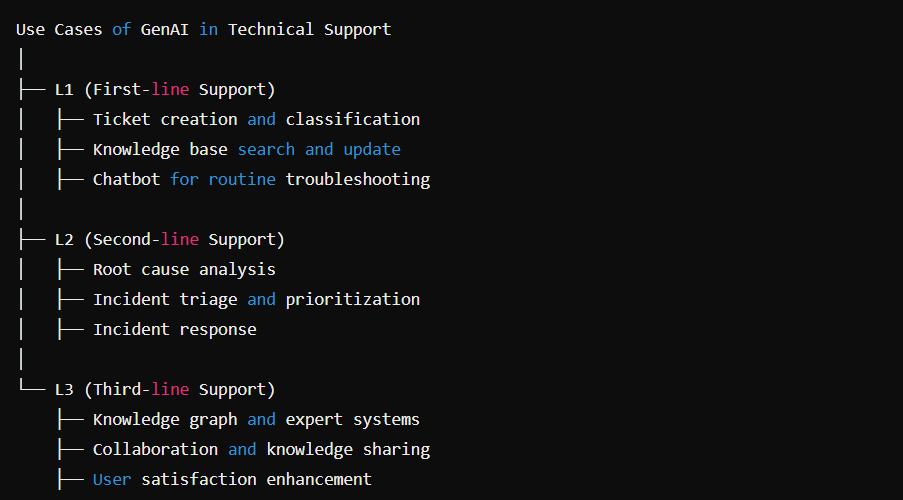
As businesses increasingly rely on technology, efficient technical support is essential for maintaining seamless operations. Traditional support structures are categorized into three levels:
- Level 1 (L1): Handles basic user inquiries and common troubleshooting.
- Level 2 (L2): Manages more complex issues requiring deeper investigation.
- Level 3 (L3): Addresses advanced problems, including root cause analysis and system-level troubleshooting.
By integrating Generative AI into each level, organizations can automate responses, improve resolution speed, enhance customer satisfaction, and optimize support workflows. Below are some key use cases demonstrating how AI is transforming technical support at every level:
L1 (First-line support): Automating routine queries & troubleshooting
At this level, AI enhances efficiency by handling common inquiries, automating ticketing, and providing self-service options, reducing the workload on human agents.
- Automated ticket creation & classification: AI generates and categorizes support tickets automatically, ensuring they are routed to the appropriate teams based on urgency and complexity.
- Enhanced knowledge base & self-service: AI-powered tools analyze past support tickets and automatically update knowledge base articles, ensuring customers and agents have access to the latest troubleshooting guides.
- AI-powered chatbots for routine troubleshooting: Conversational AI handles basic troubleshooting queries, helping customers resolve common IT issues such as password resets and software installations without human intervention.
- Proactive issue detection: AI monitors system performance and user behavior, detecting potential problems before they escalate and providing proactive alerts to both users and support teams.
L2 (Second-line support): Handling complex issues & incident management
At this level, AI enhances the efficiency of support teams by analyzing logs, prioritizing tickets, and assisting with security incident management.
- AI-driven root cause analysis: AI analyzes system logs, error messages, and historical data to identify the source of complex technical issues, providing solutions faster.
- Smart incident triage & prioritization: AI assesses the severity and impact of support tickets, automatically prioritizing high-impact issues and ensuring urgent cases are addressed first.
- Incident report automation: AI-generated incident reports streamline documentation, ensuring accurate, detailed records for compliance, audits, and performance analysis.
L3 (Third-line support): Advanced troubleshooting & AI-assisted engineering
For highly complex technical issues, AI assists engineers by analyzing large data sets, providing debugging support, and facilitating knowledge sharing.
- Advanced troubleshooting & system diagnostics: AI reviews extensive logs and detects hidden patterns, helping engineers uncover root causes of recurring technical issues.
- AI-assisted code generation & debugging: AI suggests code snippets, identifies errors, and offers debugging recommendations, accelerating software troubleshooting and development.
- Building intelligent knowledge graphs: AI creates structured knowledge graphs, linking technical concepts, previous cases, and solutions, making it easier for support teams to find answers quickly.
- Enhancing collaboration & knowledge sharing: AI-powered collaboration tools allow engineers to document solutions, share insights, and improve problem-solving across teams, fostering continuous learning.
Generative AI is redefining technical support by streamlining workflows, reducing response times, and improving the overall customer experience. Whether it’s automating routine queries, assisting with complex troubleshooting, or enhancing knowledge management, AI is empowering support teams to operate more efficiently while delivering faster, more accurate solutions.
As AI continues to evolve, businesses that embrace AI-driven support solutions will gain a competitive edge, delivering smarter, scalable, and customer-centric support experiences for the future.
Measuring ROI: How generative AI boosts cost efficiency & performance

Investing in Generative AI for technical support isn’t just about innovation, it’s about tangible business results. By streamlining processes, automating repetitive tasks, and enhancing customer interactions, AI significantly reduces costs, boosts efficiency, and improves customer satisfaction. But how do businesses measure the return on investment (ROI) of AI-driven support solutions? Let’s break it down:
Cost savings: Cutting operational expenses
One of the biggest advantages of AI-powered technical support is the reduction in human intervention for repetitive tasks. Instead of staffing large support teams, companies can leverage AI chatbots, automated ticketing systems, and self-service solutions to handle a significant portion of inquiries.
- Fewer support agents needed for L1 issues → More focus on complex cases.
- Lower call center and infrastructure costs → AI handles inquiries at scale.
- Reduction in costly human errors → AI provides consistent, data-driven responses.
Increased productivity: Faster resolutions, more efficient teams
AI doesn’t just replace manual work, it makes support teams more efficient. By automating routine processes and assisting human agents with real-time recommendations, AI enables faster issue resolution and higher agent productivity.
- Improved handling capacity: Support agents utilizing AI handle 13.8% more customer inquiries per hour.
- Real-time AI suggestions help agents resolve issues 30–50% faster.
- AI-assisted troubleshooting reduces back-and-forth communication, shortening resolution times.
Customer satisfaction: Faster, smarter, and more personalized support
Customers today expect quick, accurate, and effortless support. AI eliminates long wait times, provides instant answers, and ensures more personalized interactions, all of which contribute to higher customer satisfaction metrics.
- Higher CSAT (Customer Satisfaction Score): AI reduces frustration by cutting wait times and providing precise, helpful responses.
- Better NPS (Net Promoter Score): Faster issue resolution improves brand perception and customer loyalty.
- Personalized support: AI remembers past interactions, offering context-aware solutions that make customers feel valued.
Generative AI isn’t just a futuristic tool, it’s a practical investment that reduces costs, enhances productivity, and elevates customer satisfaction. Businesses that integrate AI-driven support solutions gain a competitive edge, providing faster, smarter, and more efficient service while significantly improving their bottom line.
Want to see these results for yourself? Now’s the time to embrace AI and transform your technical support operations!
Future innovations: What’s next for generative AI in customer support?
Generative AI has already revolutionized customer support, but we’re just scratching the surface. The next wave of AI advancements promises to make customer interactions even more intuitive, personalized, and immersive. As businesses continue to adopt AI-driven solutions, these emerging innovations will shape the future of customer service:
Hyper-personalized AI interactions
Forget generic responses, AI will soon deliver highly tailored support experiences based on individual customer preferences, history, and real-time needs.
- AI will predict customer issues before they arise, offering proactive solutions.
- Virtual assistants will remember past interactions, adapting their tone and recommendations for each user.
- Support interactions will feel more human-like and conversational, making AI an indispensable customer service companion.
Multimodal AI support (Voice, text & video integration)
Today’s AI is mostly text-based, but the future belongs to multimodal AI, a seamless blend of voice, text, images, and even video assistance.
- AI will analyze customer emotions through voice tone and adjust responses accordingly.
- AI-powered video support will allow real-time screen-sharing and interactive troubleshooting.
- Smart assistants will provide step-by-step guidance using visuals and voice commands.
AI-powered integration with IoT & AR/VR
As smart devices and immersive technologies become more common, AI-driven support will extend beyond traditional customer service platforms.
- IoT integration: AI-powered virtual assistants will work directly within smart home devices, cars, and wearables, offering instant troubleshooting.
- AR/VR customer support: Instead of reading long troubleshooting guides, customers can use AR-powered AI assistants to get real-time, visual instructions for complex issues.
- AI will predict device malfunctions before they occur, reducing downtime and improving user experience.
Ethical considerations & data security
As AI becomes more deeply integrated into customer interactions, businesses must balance automation with privacy, compliance, and ethical AI usage.
- Stronger AI governance will ensure transparency and fairness in automated decision-making.
- AI will be designed to comply with global data privacy laws (e.g., GDPR, CCPA), safeguarding customer information.
- Businesses will need to implement clear guidelines on AI-human collaboration, ensuring AI enhances, not replaces, human support.
Generative AI is evolving beyond simple automation, it’s becoming an intelligent, proactive, and deeply personalized support system. As businesses invest in hyper-personalized AI, multimodal interactions, IoT integration, and responsible AI practices, customer support will shift from reactive problem-solving to proactive, intuitive, and seamless assistance.
The future of AI-driven support is smarter, more human-like, and effortlessly integrated into daily life and businesses that embrace these innovations will lead the way in customer experience excellence.
Conclusion
Generative AI is no longer just a futuristic concept, it’s actively reshaping technical support, making it smarter, faster, and more efficient. By automating repetitive tasks, enhancing human-agent productivity, and delivering hyper-personalized experiences, AI is setting a new benchmark for customer service excellence.
From AI-powered chatbots and smart ticketing to multimodal interactions and predictive troubleshooting, businesses that leverage AI-driven support solutions gain a competitive edge, offering customers seamless, 24/7 assistance while optimizing operational efficiency.
Looking ahead, the evolution of hyper-personalized AI, AR/VR integration, and ethical AI governance will further refine customer interactions, ensuring support systems are not just reactive, but proactive and intuitive. Companies that embrace these advancements will lead the way in delivering exceptional customer experiences while maximizing ROI and efficiency.
Now is the time to integrate Generative AI into your technical support strategy. The future of customer service isn’t just automated, it’s intelligent, adaptive, and customer-centric.