In today’s fast-paced business world, sales teams struggle to meet rising customer expectations while managing complex buyer journeys. Traditional CRM systems help, but manual tasks, lack of actionable insights, and limited personalization often lead to missed opportunities.
Generative AI is transforming sales operations by automating repetitive tasks like lead qualification, personalized proposal generation, and real-time data analysis. This technology frees up sales professionals to focus on relationship-building and closing deals instead of administrative work.
With the growing demand for hyper-personalized customer experiences, generic outreach is becoming ineffective. Generative AI helps anticipate customer needs, craft tailored communication, and stay ahead of the competition. The market for generative AI in sales, valued at $310 million in 2023, is projected to reach $850 million by 2033, growing at a CAGR of 10.9%.
This article explores how generative AI enhances sales efficiency, key use cases, integration strategies, and emerging trends shaping the future of AI-driven sales.
Generative AI in sales: Transforming operations & driving growth

Generative AI is revolutionizing sales operations, bringing automation, intelligence, and personalization to traditionally manual tasks. Powered by transformers, Large Language Models (LLMs), and Generative Adversarial Networks (GANs), this advanced technology analyzes vast datasets, identifies patterns, and generates human-like content, ranging from emails and proposals to insights and sales strategies.
By automating lead generation, customer outreach, and data analysis, generative AI is reshaping how sales teams operate, enabling them to work smarter, close deals faster, and deliver hyper-personalized customer experiences.
How generative AI is reshaping sales operations
- Automating sales processes for maximum efficiency
Generative AI eliminates repetitive tasks, allowing sales professionals to focus on strategic selling. AI-driven tools can:
- Qualify leads based on behavior and data analytics
- Generate personalized outreach emails and follow-ups
- Craft compelling proposals and sales decks in seconds
- Enhancing customer engagement through personalization
Modern buyers expect tailored interactions, and generative AI enables hyper-personalized sales pitches. AI can:
- Analyze past interactions to create customized sales recommendations
- Adjust communication strategies in real-time for maximum impact
- Predict customer needs and suggest relevant solutions
- AI-powered sales analytics & smarter decision-making
Generative AI transforms raw data into actionable insights, helping sales leaders make data-driven decisions. AI assists with:
- Predictive sales forecasting to anticipate revenue trends
- Customer sentiment analysis to refine sales strategies
- Automated reporting to track team performance and deal progress
- Revolutionizing sales training & skill development
AI-powered training tools provide:
- Real-time coaching and feedback tailored to individual reps
- Personalized learning paths based on performance metrics
- Market trend insights to help sales teams stay ahead of competitors
The impact of generative AI on sales: Key statistics
According to recent research, companies leveraging generative AI in sales have reported significant improvements:
- 84% of sales professionals using AI have seen increased revenue
- 82% utilize AI for content creation, streamlining customer interactions
- 74% leverage AI for market data analysis, enabling strategic decision-making
- 71% automate personalized sales communications, enhancing engagement
Looking ahead, sales teams expect AI to further optimize:
- Sales reporting (51%): Automated insights for tracking performance
- Content creation (48%): Faster, high-quality marketing and outreach materials.
- Market analysis (47%): AI-driven strategies to identify new opportunities
Key drivers of generative AI in sales
- Hyper-personalization: AI adapts messaging and solutions to individual customers, leading to higher engagement and conversion rates.
- Operational efficiency: Automating tasks like lead generation, outreach, and CRM updates reduces workloads and boosts productivity.
- Strategic Sales decisions: AI-generated insights empower sales teams to optimize pricing, forecast revenue, and refine market strategies.
As businesses continue to integrate AI-driven sales solutions, they gain a competitive edge, enhancing efficiency, improving customer relationships, and ultimately driving revenue growth.
Top use cases of generative AI in sales
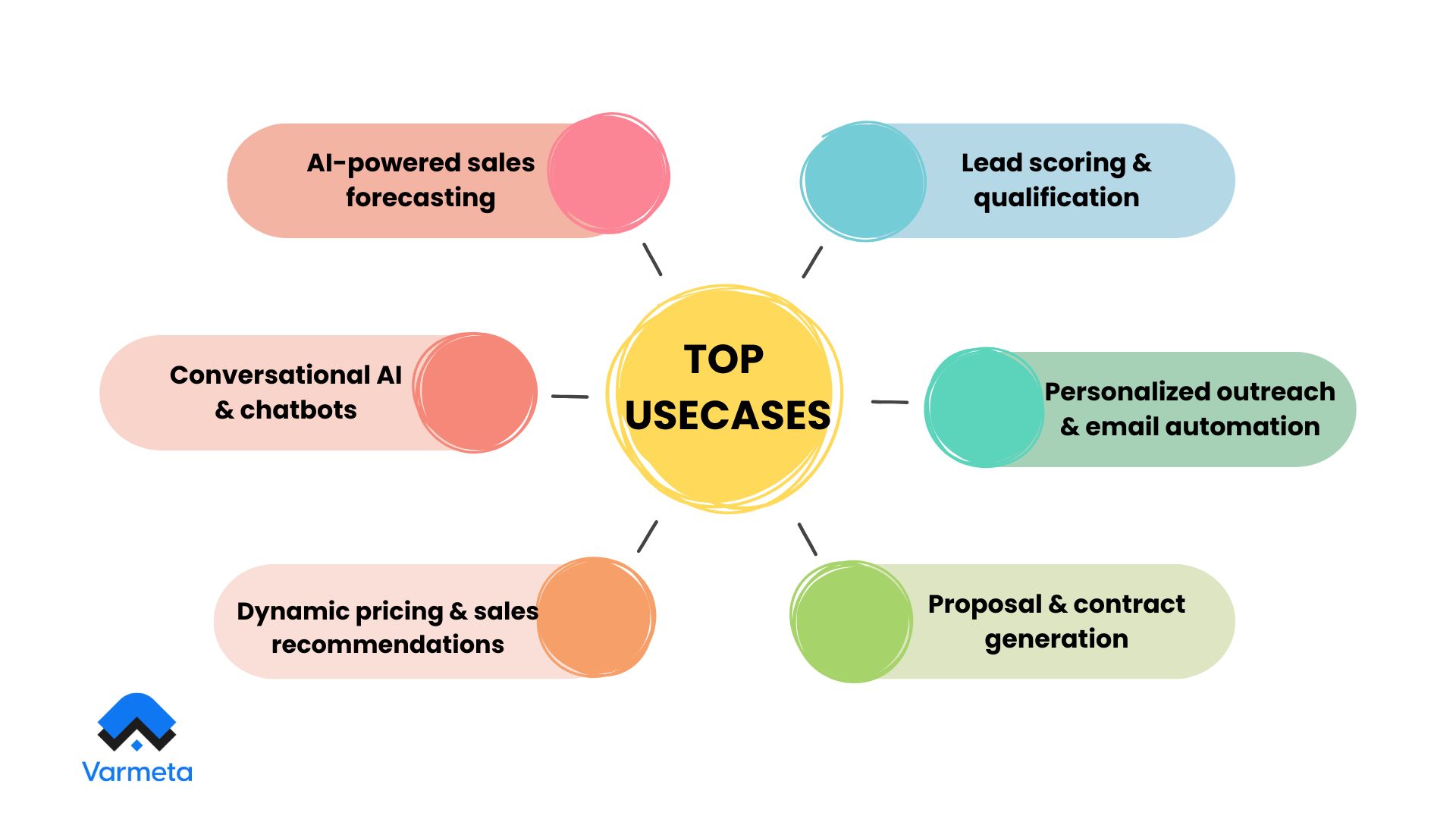
Generative AI is transforming sales by automating critical processes, enhancing personalization, and enabling data-driven decision-making. Here are the most impactful ways AI is reshaping sales operations:
1. Lead scoring & qualification
AI-powered analytics help sales teams identify and prioritize high-value leads by analyzing customer interactions, past behaviors, and purchase intent. This allows reps to focus on leads with the highest conversion potential, improving efficiency and closing rates.
2. Personalized outreach & email automation
AI streamlines customer engagement by automating email campaigns and personalized messaging at scale. By tailoring outreach based on customer preferences and behaviors, generative AI enhances response rates and strengthens relationships.
3. Proposal & contract generation
Creating sales documents manually is time-consuming. Generative AI automates the drafting of contracts, proposals, and sales agreements, ensuring accuracy while saving time. AI-generated templates can be quickly customized to fit client needs, accelerating deal closures.
4. AI-powered sales forecasting
Generative AI analyzes market trends, sales data, and customer behavior to predict future demand, revenue trends, and potential risks. These insights help businesses refine their sales strategies, set realistic targets, and allocate resources effectively.
5. Conversational AI & chatbots
AI-driven chatbots and virtual assistants handle initial customer inquiries, lead nurturing, and FAQs, ensuring that prospects receive immediate, relevant responses. This improves customer experience while allowing sales reps to focus on higher-value interactions.
6. Dynamic pricing & sales recommendations
AI optimizes pricing strategies by analyzing market conditions, competitor pricing, and customer behavior in real time. It can suggest personalized product recommendations and pricing adjustments, helping businesses maximize revenue and customer satisfaction.
By integrating generative AI into sales operations, businesses can drive efficiency, enhance customer engagement, and gain a competitive edge in an increasingly digital sales environment.
Challenges & best practices for implementing generative AI in sales
Integrating generative AI into sales operations can unlock tremendous value, but it also comes with challenges that require careful planning, strong governance, and proactive management. Below, we explore the key obstacles businesses may face and best practices to ensure a smooth AI adoption process.
Challenges of implementing generative AI in sales
- Bias & ethical considerations
- Lead prioritization bias: AI models may unintentionally favor certain customer segments if trained on biased data, leading to missed opportunities.
- Ethical messaging: Ensuring AI-generated content remains accurate, unbiased, and aligned with brand values is crucial for maintaining customer trust.
- Data privacy & security risks
- Sensitive customer data: AI systems rely on large volumes of customer information, increasing the risk of data breaches and misuse.
- Regulatory compliance: Businesses must adhere to global privacy laws (GDPR, CCPA, etc.), which can be complex when deploying AI-driven insights at scale.
- Transparency & trust issues
- AI hallucinations: Generative AI sometimes produces inaccurate or misleading recommendations, potentially harming decision-making.
- Opaque decision-making: Sales teams may struggle to trust AI outputs if they lack clear insights into how AI reaches conclusions.
- Integration & operational challenges
- System compatibility: Merging AI tools with existing CRMs, sales platforms, and data systems can be technically demanding.
- Continuous fine-tuning: AI models require regular updates to stay relevant as customer preferences and market trends evolve.
- Adoption & cultural resistance
- Fear of automation: Some sales professionals worry that AI will replace their roles or diminish the human touch in customer interactions.
- Training barriers: Effective AI adoption requires ongoing education to ensure teams know how to leverage AI tools effectively.
Best practices for seamless AI integration in sales

- Build ethical & responsible AI
- Regularly audit AI-generated outputs to detect biases and refine algorithms.
- Partner with trusted AI vendors that uphold ethical AI principles and provide transparency.
- Strengthen data privacy & security
- Implement advanced encryption, access controls, and data anonymization to protect sensitive information.
- Align AI usage with global compliance standards (GDPR, CCPA, etc.) to avoid legal risks.
- Foster transparency & trust
- Provide clear explanations of AI-generated insights to improve user confidence.
- Use explainable AI (XAI) models that allow sales teams to understand the reasoning behind AI-driven recommendations.
- Start small & scale gradually
- Begin with low-risk AI applications, such as email personalization or sales call summaries, before expanding into lead qualification and forecasting.
- Run pilot programs with select teams before rolling out AI company-wide.
- Train & empower sales teams
- Offer ongoing AI training to help sales teams integrate AI into their daily workflows effectively.
- Promote AI as a collaborative tool that enhances rather than replaces human decision-making.
- Enable continuous AI optimization
- Regularly update AI models based on user feedback to ensure accuracy and relevance.
- Monitor AI performance metrics to fine-tune strategies and improve effectiveness.
- Balance AI automation with human expertise
- Use AI to augment human intuition and strategic thinking, especially in negotiation and relationship-building.
- Ensure that AI-generated content and recommendations always include a human review process before final implementation.
Unlocking the full potential of generative AI in sales
When implemented thoughtfully, generative AI can revolutionize sales operations, enhancing productivity, customer interactions, and revenue growth. However, success requires ethical AI practices, strong security measures, transparent decision-making, and proper team training.
With the right approach, businesses can fully leverage AI to automate processes, optimize sales strategies, and gain a competitive edge, all while maintaining the human touch that drives lasting customer relationships.
The future of generative AI in sales: What’s next?
As sales strategies continue to evolve, generative AI is set to revolutionize sales operations, enabling smarter engagement, hyper-personalization, and increased efficiency. Here’s how AI-driven innovations will shape the future of sales:
- AI-powered customer engagement platforms
Sales engagement tools will become more intuitive and conversational, powered by AI-driven recommendations and automation. These smart platforms will deliver real-time insights, making interactions smoother, more personalized, and data-driven allowing sales teams to close deals faster and with greater accuracy.
- Hyper-personalized sales experiences
With deep learning and predictive analytics, generative AI will refine customer engagement by automating lead nurturing, customizing sales pitches, and delivering targeted offers. AI-driven personalization will reduce generic outreach, allowing sales reps to focus on high-value interactions while AI handles repetitive tasks.
- Real-time sales intelligence & smart recommendations
AI will analyze customer behavior, preferences, and historical data in real time, providing instant recommendations for sales teams. Whether suggesting the best products, identifying upselling opportunities, or tailoring responses on the fly, AI-powered insights will help boost sales performance and customer satisfaction.
- A fully data-driven sales ecosystem
Generative AI will empower sales teams with data-backed decision-making, allowing them to react to market shifts, customer trends, and competitor strategies in real time. By enhancing lead scoring, pipeline forecasting, and sales analytics, AI will drive better conversion rates and optimized sales operations.
- Optimized sales team performance
AI will not only improve customer-facing sales efforts but also enhance team dynamics, sales strategies, and communication efficiency. By analyzing performance data, AI can recommend more effective sales techniques, team compositions, and training programs, fostering a more agile and results-driven sales force.
- Continuous learning & adaptive sales training
AI-driven sales training will become more dynamic, with platforms offering personalized coaching based on real-time industry trends and sales performance. Sales teams will receive adaptive learning modules that help them stay ahead of evolving customer needs and market demands.
- Ethical AI in sales: Transparency & fairness
As AI takes on a larger role in sales decision-making, there will be a greater emphasis on ethical AI governance. Companies will adopt AI frameworks that prioritize transparency, reduce bias, and ensure fairness in sales processes, fostering stronger customer trust and compliance with industry regulations.
- Intelligent resource & territory management
Generative AI will streamline resource allocation by automating lead prioritization, optimizing sales territories, and improving time management. By matching the right sales reps with the best opportunities, AI will maximize efficiency, reduce wasted efforts, and drive higher revenue growth.
Conclusion
Generative AI is revolutionizing sales operations, transforming how businesses engage customers, optimize workflows, and drive revenue. By automating repetitive tasks, enhancing personalization, and providing data-driven insights, AI enables sales teams to work smarter, close deals faster, and create hyper-personalized customer experiences.
However, to unlock its full potential, businesses must address key challenges, including data privacy, AI bias, transparency, and team adoption. Implementing best practices, ensuring ethical AI use, fostering transparency, prioritizing security, and balancing automation with human expertise is essential for long-term success.
Looking ahead, generative AI will continue to evolve and shape the future of sales, enabling real-time sales intelligence, predictive analytics, and AI-driven customer engagement platforms. Organizations that embrace AI strategically will gain a competitive edge, boost efficiency, improve customer relationships, and achieve sustainable sales growth in an increasingly digital marketplace.