Retirement financial planning has always been an exercise in managing uncertainty over decades. A person in their 30s must make decisions today that will determine their financial security in their 70s or 80s without knowing how markets will perform, how long they will live, or what healthcare will cost. The same challenge faces pension funds operating across thousands or millions of participants at once.
The structural pressure on these systems is growing. According to the United Nations World Population Prospects 2022, the global share of people aged 65 and over is projected to nearly double from 10% in 2022 to 16% by 2050. Longer lifespans and aging populations are increasing the duration and cost of retirement while also straining the pension systems designed to support it.
Traditional planning models were not built for this degree of complexity. They rely on fixed assumptions, infrequent updates, and broad generalization approaches that work reasonably well in stable conditions but struggle to stay accurate over a 30- or 40-year horizon.
AI changes the core dynamic. Not by eliminating uncertainty, but by making retirement systems more adaptive, capable of responding to change as it happens rather than waiting for the next scheduled review.
What is retirement financial planning?

Retirement financial planning is the process of building and managing financial resources to sustain a person’s standard of living after regular employment income ends or declines.
It typically spans five interconnected areas:
- Income planning: identifying sources of retirement income: state pensions, employer pensions, personal savings, and passive income streams
- Accumulation strategy: determining how much to save, where to invest, and how to grow wealth over the working years
- Risk management: accounting for longevity risk, inflation, market volatility, and healthcare costs
- Withdrawal planning: structuring how and when to draw down assets to avoid running out of money
- Ongoing adjustment: revisiting and updating the plan as life circumstances, markets, and regulations change
The core challenge is not simply accumulating enough money. It is ensuring that money can last under conditions that no one can fully predict.
Why traditional retirement planning often falls short
Traditional retirement planning models are built on a set of assumptions that made practical sense when they were designed but which create meaningful risk when applied over multi-decade horizons.
Fixed return assumptions smooth out volatility in ways that look clean on a spreadsheet but do not reflect how markets actually behave. A plan that assumes 6% annual growth for 35 years will produce very different outcomes depending on the sequence of returns, a concept known as sequence-of-returns risks that many generic models are still underweight.
Average life expectancy creates a systemic blind spot. Using population averages means that roughly half of all retirees will outlive their projected lifespan and their savings. For women, who statistically live longer than men, this gap is larger.
Infrequent updates mean that plans drift from reality. A financial plan reviewed every two or three years cannot reflect the contribution gaps, spending shifts, or portfolio changes that have occurred in the interim. By the time an issue is detected, it may already be significant.
Broad categorization reduces accuracy at the individual level. Grouping people into risk profiles conservative, moderate, aggressive makes planning easier to scale but less meaningful to any individual participant. Real financial behavior does not fit neatly into three buckets.
The result is not that traditional planning fails entirely. It is that the gap between plan and reality tends to widen over time quietly, until it becomes a problem that is difficult to reverse.
Traditional vs AI-Driven retirement financial planning
| Aspect | Traditional Retirement Planning | AI-Driven Retirement Planning |
| Planning approach | Based on fixed assumptions and periodic reviews | Continuously updated based on real-time or frequent data |
| Personalization | Limited, grouped into broad profiles | Personalized based on behavior and financial patterns |
| Risk management | Uses static models and historical averages | Uses dynamic forecasting and multiple scenarios |
| Adjustment frequency | Annual or event-based | Continuous monitoring and adjustment |
| Decision support | Manual and often delayed | Automated insights with faster recommendations |
| Scalability | Hard to scale personalization | Scales across large populations with individual outputs |
| Accuracy over time | Can drift from reality | Improves with ongoing data updates |
Traditional retirement planning works well when conditions remain stable, but becomes less reliable as more variables change. Fixed assumptions and infrequent updates make it difficult to keep plans aligned with actual financial behavior and market conditions.
AI-driven approaches address this by continuously updating inputs and adjusting outputs. Instead of relying on a single projection, the system can respond to changes in income, spending, and market performance as they happen.
The difference becomes more important at scale. For pension funds or large retirement platforms, manual processes limit personalization. AI allows individualized planning while managing a large number of participants, improving both efficiency and outcomes.
How AI is changing retirement financial planning
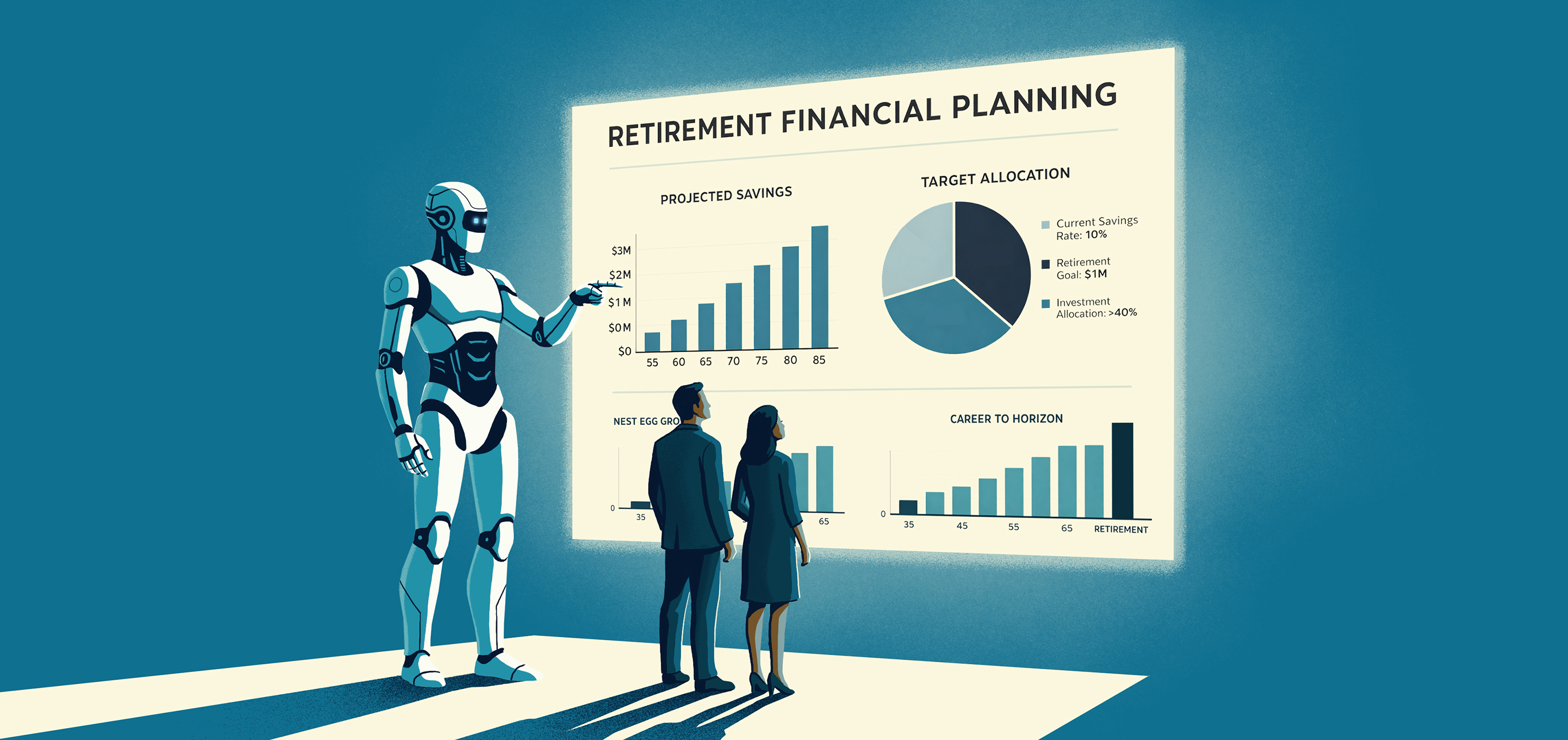
AI improves retirement financial planning by making the system more adaptive. Instead of relying only on periodic estimates, AI can analyze live or frequently updated data and use it to refine recommendations, detect changes, and support better decisions over time.
Continuous monitoring of financial behavior
A strong retirement plan depends on what actually happens, not on what was expected to happen three years ago. AI can track contribution behavior, salary trends, spending patterns, portfolio changes, and external market signals more continuously than traditional review systems.
This matters because early detection changes the quality of decision-making. If contributions fall below the level needed to meet retirement goals, the system can identify the shortfall sooner. If spending habits are eroding long-term savings capacity, that pattern can be flagged before it becomes a structural problem. In this way, AI supports retirement planning by reducing the lag between change and response.
Better personalization
AI is well suited to retirement planning because the problem is deeply personal. It involves behavior, risk tolerance, goals, and constraints that vary widely across individuals.
Rather than assigning people to broad generic models, AI can build more detailed profiles based on contribution history, income volatility, expected retirement horizon, spending needs, and changing financial priorities. This does not mean every user needs a fully unique investment strategy, but it does mean recommendations can become more relevant and more realistic.
In retirement planning, personalization is not a cosmetic feature. It affects real financial outcomes. A plan that better reflects a user’s life is more likely to maintain steady contributions, use an appropriate risk level, and avoid major planning gaps.
Stronger forecasting for long-term risks
Longevity risk, inflation risk, and healthcare cost risk are not dramatic events, they are slow, compounding pressures that gradually erode retirement security. Traditional models address them with historical averages. AI can do more.
By running probabilistic scenario models across thousands of simulated outcomes, AI-driven systems can quantify the range of realistic futures rather than projecting a single expected path. A plan might show that under median conditions, a participant is on track but under the 75th percentile for longevity and healthcare inflation, there is a meaningful shortfall. That distinction is actionable. A single-number projection is not.
A 2024 report by the CFA Institute Research and Policy Center: Pensions in the Age of Artificial Intelligence, identifies actuarial analysis and predictive analytics as key areas where AI can add value: specifically, advanced ML techniques may improve actuarial assumptions, strengthen asset/liability management, and support pension de-risking strategies. For DC plans, the report highlights the potential for accumulation and decumulation strategies personalized to individual member behavior, a level of customization that static models are not designed to deliver.
Improved decision support
Many retirement planning failures are not caused by a lack of products. They are caused by a lack of clear, timely decisions. People delay increasing contributions because they are unsure whether it matters. They avoid rebalancing because the options feel overwhelming. They do not change withdrawal strategies because no one has shown them the consequences of not changing.
AI can close this gap by translating complex analysis into concrete guidance. Showing a participant that increasing monthly contributions by 3% today would improve projected retirement income by 18% over 25 years is not just informative, it is motivating. Clear, timely, personalized decision prompts change behavior in ways that periodic statements and generic newsletters do not.
AI in retirement financial planning for pension funds
The role of AI becomes even more strategically important at the institutional level. Pension funds operate under unique constraints: they manage long-horizon liabilities across large populations, operate within strict regulatory frameworks, and are accountable to both participants and trustees for outcomes that unfold over decades.
Portfolio and risk management
Pension funds must balance the need for growth with the obligation to meet future liabilities. Traditional asset allocation frameworks rely heavily on historical correlations and volatility assumptions, which can break down precisely when they are needed most, as the 2008 financial crisis demonstrated.
AI can improve this in several ways: identifying non-linear relationships between asset classes, stress-testing portfolios against tail-risk scenarios, improving liquidity forecasting, and flagging when current allocations are drifting from liability-matching targets. The goal is not to replace investment committees, but to give them better inputs.
Member-level analysis
One of the most underutilized opportunities in pension fund management is participant-level data. Most funds have access to years of contribution records, enrollment changes, and benefit elections, but this data often sits in siloed systems that are difficult to analyze at scale.
AI can segment participants by retirement readiness, identify cohorts at risk of significant income gaps, and enable targeted interventions: contribution nudges, enrollment reminders, personalized projections, or escalated outreach for members approaching retirement with inadequate savings.
Research on behavioral nudges in retirement savings including the landmark Madrian & Shea (2001) study and follow-up Vanguard research (Clark & Young, 2018) has consistently shown that well-designed defaults can drive participation rates from under 50% to over 90%. More recent NBER research (Choi, Laibson et al., 2024) confirms that automatic enrollment alone increased net contribution rates by an average of 0.6% of income. AI-powered nudges, personalized, timely, and behavior-driven represent the next step beyond static defaults.
Compliance, fraud detection, and data quality
Pension systems handle sensitive financial records over decades, and the administrative burden of maintaining data integrity is significant. AI can support this layer through automated anomaly detection, flagging irregular contribution patterns, identifying potential claims fraud, and improving record reconciliation.
These operational improvements matter more than they might appear. For a fund with 200,000 participants, even a 0.5% error rate in records represents 1,000 cases that require manual review. Reducing that through AI-assisted data quality processes is not just an efficiency gain, it is a governance improvement.
Key benefits of AI in retirement financial planning

The value of AI in retirement financial planning comes from how it changes the way decisions are made over time, rather than from any single feature.
In traditional models, decisions are often based on limited data and updated infrequently. This creates a gap between what the plan assumes and what actually happens. AI reduces this gap by continuously incorporating new data, allowing projections and recommendations to stay closer to real financial behavior.
As a result, planning becomes more accurate over time. Instead of relying on a fixed set of assumptions, the system can adjust to changes in income, spending, and market conditions. This also makes recommendations more relevant to each individual, since they are based on actual patterns rather than generalized profiles.
Another important impact is on risk. Many retirement risks, such as under-saving or unsustainable withdrawal rates, build gradually and are difficult to detect early. AI improves visibility into these issues, making it easier to identify and address them before they become significant problems.
At the same time, these improvements can be applied at scale. Pension providers and financial platforms can support large numbers of users while still maintaining a level of personalization that would be difficult to achieve through manual processes alone.
Finally, AI helps translate complex financial planning into clearer guidance. Instead of requiring users to interpret projections and scenarios on their own, systems can provide more direct and timely suggestions, which improves decision-making consistency over the long term.
In retirement planning, outcomes are shaped by many small decisions made over many years. By improving how these decisions are informed and when they are made, AI can have a meaningful impact on long-term financial security.
Challenges and limitations of AI in retirement financial planning
AI can improve retirement planning, but it should not be treated as a complete solution. Its effectiveness depends on how well underlying data, models, and processes are managed.
One of the most fundamental challenges is data quality. Retirement planning relies on long-term records such as contributions, income history, and financial behavior. If this data is incomplete or outdated, the output of any AI system will be unreliable. Models do not correct weak data; they often amplify its limitations.
Explainability also plays a critical role. Retirement decisions involve tradeoffs that need to be understood by users, administrators, and regulators. If a system produces recommendations without clear reasoning, it becomes difficult to trust or validate those outcomes, regardless of their accuracy.
There is also a risk of relying too heavily on automation. Retirement planning is not only a technical exercise. It involves personal goals, changing life circumstances, and subjective decisions. AI can support these decisions, but it should not replace human judgment where context matters.
Finally, privacy and governance remain central concerns. Retirement systems handle sensitive financial and personal data over long periods. This requires strong controls around data usage, clear consent mechanisms, and ongoing monitoring to ensure that systems operate within regulatory and ethical boundaries.
A practical model for AI-driven retirement planning
The most effective AI-driven retirement planning systems are not defined by any single feature. They are defined by how well data, analysis, and decision-making are connected into a coherent, continuously updated process.
Data infrastructure is the foundation. Contribution records, income histories, portfolio data, and spending patterns need to be consistently structured and regularly updated. Without this, forecasting and personalization operate on a flawed base.
Analytical capability turns data into insight. This means modeling future income needs, running probabilistic scenarios, quantifying risks, and identifying participants who are drifting off track. The output should not be a single projection, it should be a realistic range of outcomes with clear implications.
Decision integration closes the loop. Analysis only improves outcomes when it leads to action whether that is adjusting contribution rates, rebalancing portfolios, revising withdrawal plans, or triggering targeted outreach. Insights that exist in a dashboard but never reach participants or advisors have limited value.
Governance and oversight ensure reliability. AI systems in financial services need to be auditable, explainable, and regularly validated. This is not a compliance checkbox, it is what allows institutions to trust and scale these systems over time.
When these elements work together, the compound effect is substantial. Better data improves modeling. Better modeling supports better decisions. Better decisions, made earlier and more consistently, drive materially better retirement outcomes.
What this means for Technology Companies and Financial Institutions
For financial institutions, retirement planning is no longer just about offering products. It is about maintaining systems that can support long-term financial decisions under changing conditions.
This requires combining several capabilities into a single operating environment. Data needs to be reliable and continuously updated. Forecasting needs to reflect uncertainty rather than fixed assumptions. Decision-making needs to be timely and actionable. At the same time, governance needs to ensure that everything remains transparent, compliant, and controlled.
Pension funds face an additional challenge because they operate at scale. They need to manage large populations while still improving outcomes at the individual level. This creates pressure to move beyond manual processes and toward systems that can adapt without losing oversight.
For technology companies, the opportunity lies in building these systems rather than focusing on surface-level features. A retirement platform is not defined by its interface, but by how well it connects data, analysis, and decision-making in a reliable way.
The firms that get this right will not just improve efficiency. They will improve outcomes for the people whose financial security depends on these systems.
FAQ
1. What is retirement financial planning?
Retirement financial planning is the process of preparing savings, investments, income, and risk strategies to support financial security after regular employment income declines or ends.
2. How does ai help in retirement financial planning?
AI helps by improving forecasting, personalizing recommendations, monitoring contribution behavior, identifying risks earlier, and supporting better pension and retirement decisions over time.
3. Can AI manage a pension fund?
AI can support pension fund management through risk analysis, forecasting, operational monitoring, and member segmentation. It can improve decisions, but it still needs governance and human oversight.
4. Why is personalization important in retirement planning?
Personalization matters because retirement outcomes depend on individual income, spending behavior, goals, family needs, and risk tolerance. Generic planning models often miss these differences.
5. What are the risks of using ai in retirement planning?
The main risks include poor data quality, biased models, weak explainability, privacy concerns, and over-reliance on automated recommendations.
Conclusion
Retirement financial planning is becoming more demanding because the future is harder to simplify than it used to be. People live longer, markets shift faster, and retirement outcomes depend on many variables that do not stay fixed.
AI matters in this context because it helps retirement planning become more adaptive. It can improve how plans are built, how risks are monitored, and how pension systems support people over time. That does not make retirement planning effortless. It makes it more responsive to reality.
The long-term value of AI in retirement financial planning will depend on how well it is implemented. Strong systems will combine forecasting, personalization, governance, and clear decision support. Weak systems will produce more outputs without improving outcomes.
In retirement planning, that distinction matters. The goal is not to generate more recommendations. The goal is to help people and institutions make better long-term financial decisions that can hold up over time.
Ready to Build an AI-Driven Retirement Planning System?
At Varmeta, we design and build the data infrastructure, forecasting architecture, and decision-support systems that financial institutions and pension funds need to deliver adaptive, personalized retirement planning at scale.
If you’re evaluating how AI can strengthen your retirement platform, whether you manage 10,000 participants or 10 million, we’d like to have that conversation.