Imagine running a company where AI doesn’t just assist, it actively adapts, strategizes, and solves problems in real time. An advanced AI system can detect engagement trends, analyze underlying causes, and automatically refine your approach to optimize results. This is the power of agentic AI, a technology capable of operating autonomously, understanding objectives, and making decisions that drive business success.
With AI expected to contribute $826 billion to the global economy by 2030, ignoring its potential is no longer an option. From enhancing efficiency and automating workflows to identifying untapped opportunities, agentic AI is transforming how businesses operate.
In this blog, we’ll explore the core components of agentic AI frameworks, how they function, and their real-world impact on organizations. By the end, you’ll see how building intelligent, self-improving applications can unlock new levels of productivity and innovation. Let’s dive in!
What is agentic AI?

Agentic AI represents a new frontier in artificial intelligence, moving beyond passive automation to create AI systems that can act independently, make decisions, and adapt to changing situations all with minimal human intervention. Unlike traditional AI, which typically follows pre-set rules or responds to direct inputs, agentic AI is goal-driven, self-improving, and capable of reasoning through complex tasks in real time.
At its core, agentic AI understands objectives, evaluates the best course of action, and autonomously executes tasks to achieve optimal results. It doesn’t just analyze data; it takes initiative whether that means adjusting marketing strategies, optimizing supply chains, or identifying new business opportunities before they even arise.
This shift toward autonomous AI opens the door for more intelligent, efficient, and proactive applications across industries. Businesses can leverage agentic AI to handle complex workflows, automate decision-making, and continuously refine processes, making it a powerful tool for scaling operations and staying ahead in an increasingly AI-driven world.
Core components of agentic AI in building intelligent applications
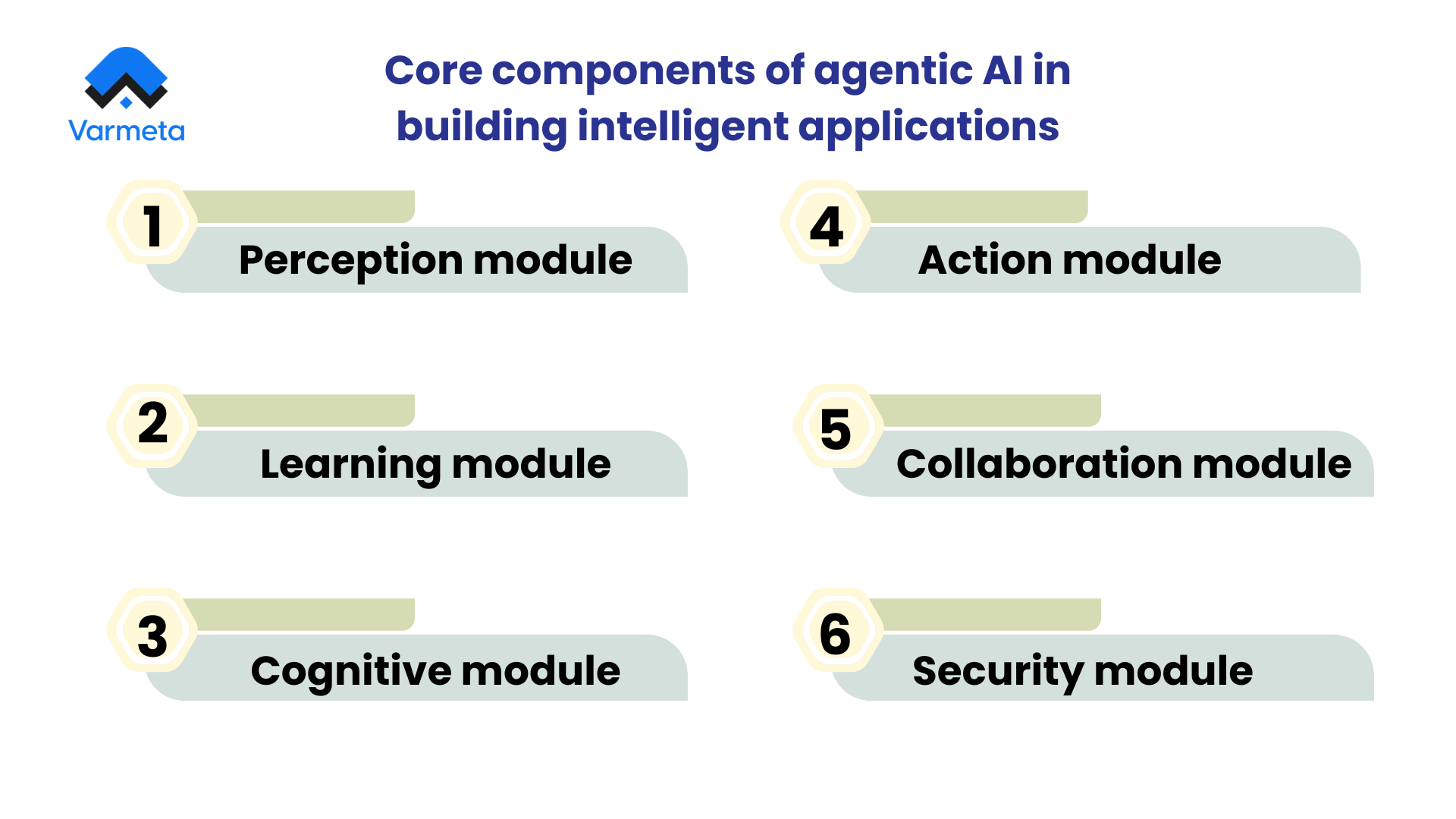
Agentic AI isn’t just about automation, it’s about creating AI systems that can perceive, learn, reason, act, and collaborate autonomously. To build truly intelligent and self-sufficient applications, several key components must work together seamlessly. Here’s a breakdown of the essential modules that power agentic AI:
1. Perception module: Understanding the world in real-time
Just like humans rely on senses, agentic AI needs perception to interpret its environment. This module processes data from multiple sources, text, speech, images, and sensors to gain situational awareness. Whether it’s recognizing customer sentiment, analyzing financial trends, or monitoring security threats, the perception module enables AI to react intelligently to real-world inputs.
2. Learning module: Constant improvement through experience
Static AI models become outdated quickly, but agentic AI learns and evolves over time. The learning module absorbs new data, refines algorithms, and adapts to changing conditions. Whether through reinforcement learning, self-supervised learning, or real-time feedback loops, this module ensures that AI continuously enhances its accuracy and decision-making capabilities.
3. Cognitive module: Advanced reasoning & problem-solving
At the heart of agentic AI is its ability to think critically and make informed decisions. The cognitive module enables AI to analyze complex scenarios, weigh different options, and predict potential outcomes before taking action. It mimics human reasoning, allowing AI to break down problems, detect patterns, and develop optimal strategies for achieving specific goals.
4. Action module: Executing decisions autonomously
AI isn’t just about analysis, it needs to take meaningful action. The action module enables agentic AI to carry out tasks based on its understanding and reasoning. Whether that means adjusting a marketing campaign, optimizing logistics routes, or automating a customer support response, this module ensures that AI can initiate and execute actions without human intervention.
5. Collaboration module: Seamless interaction with humans & systems
AI doesn’t work in isolation, it must integrate smoothly with other AI systems, software applications, and human users. The collaboration module enables agentic AI to communicate effectively, exchange data across platforms, and work alongside human teams in a cooperative manner. This ensures that AI remains a valuable partner rather than a disconnected tool, improving workflows and decision-making across organizations.
6. Security module: Safeguarding AI autonomy & ethical use
With great autonomy comes great responsibility. The security module ensures that AI operates safely, ethically, and within defined boundaries. It protects against cyber threats, data breaches, biased decision-making, and AI misuse by enforcing strict security protocols, ethical guidelines, and real-time monitoring mechanisms. This module is essential for building trustworthy and responsible AI applications.
Each of these core modules plays a critical role in enabling agentic AI to function as a self-sufficient, intelligent system. By combining perception, learning, reasoning, action, collaboration, and security, businesses can create highly adaptable AI applications that think, act, and improve continuously. This modular approach is the foundation for the next generation of AI-driven automation and decision-making.
The significance of AI agent frameworks
AI is rapidly evolving from a tool that follows instructions to a system that thinks, learns, and acts independently. This shift has made AI agent frameworks crucial in building intelligent, autonomous solutions that can analyze data, make decisions, and adapt to new challenges without human intervention.
At their core, AI agent frameworks provide the infrastructure for developing AI-driven systems that can operate autonomously, collaborate with other agents, and dynamically respond to real-world environments. Businesses and developers use these frameworks to streamline automation, enhance problem-solving, and improve efficiency across various industries.
The significance of AI agent frameworks extends beyond simple automation. They allow AI to go beyond reactive tasks and take proactive measures, whether in customer service, cybersecurity, finance, or supply chain management. By enabling AI to work independently yet cohesively with human teams and other AI agents, these frameworks are paving the way for a new era of intelligent systems that will revolutionize industries.
Top 5 leading agentic AI frameworks to watch in 2025
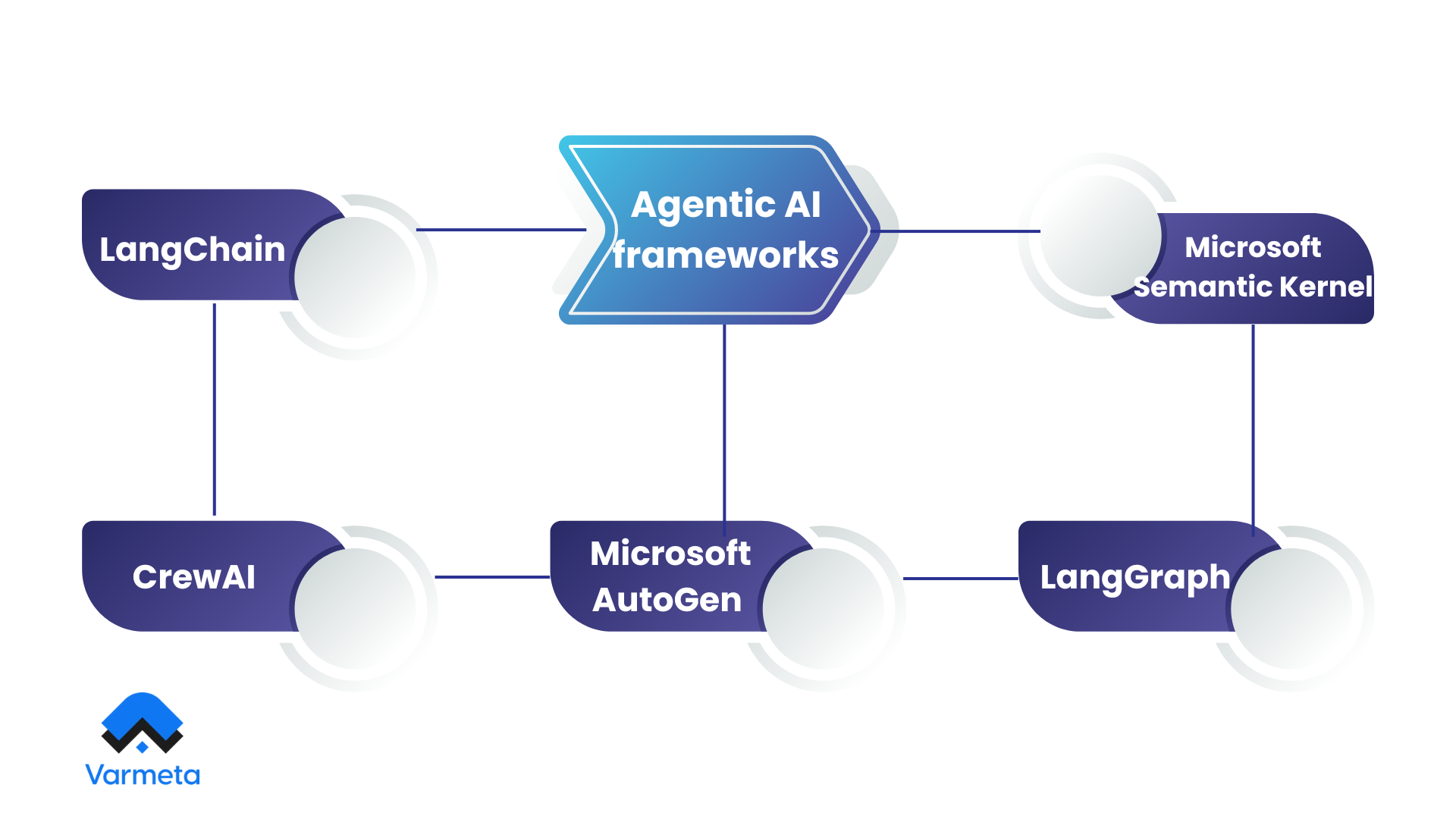
The rapid evolution of agentic AI is unlocking new frontiers in intelligent automation, enabling AI systems to make complex decisions, collaborate efficiently, and function autonomously. As businesses and developers look to build AI-powered workflows and multi-agent ecosystems, the demand for robust, scalable frameworks is growing.
Here are five cutting-edge Agentic AI frameworks that are shaping the future of autonomous AI in 2025.
1. LangChain: The backbone of AI workflow automation
LangChain has become a go-to framework for developers looking to build powerful, LLM-driven applications. It enables AI agents to seamlessly chain prompts, tools, and memory into structured pipelines, simplifying the development of complex, multi-step AI workflows.
With its modular design, LangChain allows developers to create dynamic applications, from conversational AI and document retrieval systems to financial chatbots that recall and compile customer data effortlessly. Its flexibility and integration capabilities make it a top choice for businesses integrating AI into knowledge management, automation, and intelligent assistants.
2. CrewAI: Multi-agent collaboration made seamless
CrewAI takes multi-agent coordination to the next level by allowing developers to orchestrate AI agents with defined roles and responsibilities. Inspired by human team structures, this framework helps create cohesive AI “crews” that can collaborate, divide tasks, and execute complex projects efficiently.
With a strong focus on adaptive execution, dynamic task allocation, and inter-agent communication, CrewAI enhances teamwork between AI models, making it ideal for problem-solving, strategic planning, and decision-making simulations. It is particularly useful in scenarios that require AI agents to work together, delegate tasks, and learn from interactions over time.
3. Microsoft AutoGen 0.4: AI-orchestrated autonomous systems
Microsoft AutoGen is redefining event-driven AI automation, offering a scalable framework for coordinating multiple AI agents to solve complex, distributed problems. It integrates agents with APIs, enables event-driven architectures, and optimizes task prioritization, making it a powerful tool for businesses handling large-scale automation and cloud computing.
This framework is particularly valuable for enterprise-level applications, such as IT infrastructure management and AI-driven cloud automation, where multiple AI agents work together to detect, diagnose, and resolve system issues autonomously. Its robust event-handling capabilities make it a strong contender for businesses looking to implement self-regulating AI solutions.
4. LangGraph: Multi-agent systems with memory & planning
LangGraph builds on LangChain’s foundation but introduces a graph-based approach to multi-agent AI development. It allows AI systems to retain state, plan interactions, and coordinate AI agents with structured workflows, making it ideal for dynamic, interactive AI ecosystems.
By enabling reflection, planning, and reasoning, LangGraph supports AI systems that learn from past interactions and refine their problem-solving strategies over time. This makes it particularly useful for simulating complex environments, strategic AI planning, and advanced automation, where multiple AI agents must collaborate, negotiate, or even compete to achieve goals.
5. Microsoft Semantic Kernel: AI-integrated software development
Microsoft’s Semantic Kernel bridges the gap between AI and traditional software development, allowing businesses to integrate large language models (LLMs) into existing applications without rebuilding from scratch. This lightweight, versatile framework is designed to enhance enterprise applications with AI-powered automation, reasoning, and decision-making.
What sets Semantic Kernel apart is its strong security and compliance capabilities, making it ideal for industries that require strict data governance, such as finance, healthcare, and enterprise IT. Developers can also mix and match AI models, optimizing performance and cost-efficiency based on specific use cases.
As AI becomes more autonomous and capable of executing complex workflows, agentic AI frameworks will play a crucial role in shaping how businesses deploy intelligent, decision-making AI systems. Whether it’s workflow automation, multi-agent collaboration, or enterprise AI integration, these frameworks are pushing the boundaries of what AI can achieve in 2025 and beyond.
Real-world applications of agentic AI algorithms

Agentic AI is reshaping industries by enabling systems that act autonomously, adapt to real-time data, and make intelligent decisions without constant human oversight. From automating routine tasks to tackling complex problem-solving, agentic AI is already transforming key sectors
1. Autonomous customer support & virtual assistants
Businesses are integrating agentic AI into customer service chatbots and virtual assistants that go beyond scripted responses. These AI agents can understand customer sentiment, personalize interactions, and resolve issues dynamically
Example: AI-powered support agents in banking that assist customers with transactions, detect fraudulent activities, and offer tailored financial advice all without human intervention
2. AI-driven financial trading & risk management
In finance, agentic AI is revolutionizing trading and risk assessment. AI-driven trading bots analyze market trends, news sentiment, and historical data to make autonomous trading decisions at high speed. Meanwhile, risk management systems can predict financial instability and adjust strategies accordingly
Example: Hedge funds use AI agents to monitor global economic indicators, execute real-time trades, and rebalance portfolios to maximize returns while minimizing risks
3. Automated IT infrastructure management
IT operations are increasingly relying on AI agents to monitor, diagnose, and resolve system issues before they escalate. These AI-driven systems can automatically detect server failures, optimize network performance, and apply security patches
Example: AI-driven cloud automation that manages workload distribution, predicts system failures, and autonomously fixes misconfigurations
4. Smart supply chain & logistics optimization
Agentic AI is streamlining global supply chains by forecasting demand, optimizing inventory, and managing logistics operations in real time
Example: AI-powered logistics platforms that adjust delivery routes based on real-time traffic, weather conditions, and demand fluctuations
Agentic AI is not just a futuristic concept, it’s already shaping industries today. By making autonomous decisions, learning from experience, and seamlessly integrating with human workflows, these AI agents are driving efficiency, reducing costs, and unlocking new opportunities across multiple sectors. As technology advances, we can expect AI to take even more sophisticated roles, revolutionizing the way businesses operate and innovate.
Conclusion
The rise of agentic AI frameworks marks a turning point in how businesses develop and deploy intelligent, autonomous systems. These frameworks are not just tools for automation; they are the foundation for AI systems that can think, learn, adapt, and act independently, revolutionizing industries from finance and IT to customer service and logistics.
As AI continues to evolve, companies that embrace agentic AI frameworks will gain a significant advantage boosting efficiency, improving decision-making, and unlocking new opportunities for innovation. The ability to build multi-agent systems that collaborate, strategize, and self-optimize is no longer a futuristic vision but a reality shaping how organizations operate today.
The question is no longer whether businesses should adopt agentic AI, but how quickly they can integrate it to stay ahead. With LangChain, CrewAI, Microsoft AutoGen, LangGraph, and Semantic Kernel leading the charge, the future of AI-driven automation is more promising than ever. Those who harness these frameworks now will be at the forefront of the next wave of intelligent, adaptive, and self-sustaining AI systems.