Artificial intelligence (AI) is no longer a concept of the distant future, it’s shaping our world today, from personal assistants like Siri to self-driving cars. But as AI evolves, a new frontier is emerging: Agentic AI. This advanced form of AI is taking the technology beyond simple task execution, empowering systems to make decisions, adapt to their environments, and even pursue specific goals.
So, what is Agentic AI, and why is everyone talking about it? Imagine machines that not only follow instructions but also think critically and act autonomously. From revolutionizing healthcare to transforming transportation, Agentic AI is set to change how industries operate and how we interact with technology.
In this guide, we’ll dive into what makes Agentic AI unique, explore its potential, and uncover why it’s a key player in the future of artificial intelligence. Ready to discover how it is shaping tomorrow? Let’s get started!
What is agentic AI?

Agentic AI, or Agentic Artificial Intelligence, refers to an advanced form of AI designed to operate with autonomy, make decisions independently, and pursue specific goals. Unlike simpler forms of AI, Agentic AI doesn’t just react to inputs or follow pre-programmed rules, it actively seeks solutions, adapts to new information, and behaves in a goal-oriented manner.
To understand Agentic AI better, let’s compare it with other types of AI:
- Reactive AI: These systems can only respond to immediate inputs and lack the ability to store or use past experiences. Think of them as purely task-specific.
- Limited memory AI: This type can use past data for decision-making but only within a predefined scope.
- Agentic AI: This takes things further by combining memory, learning, and autonomous decision-making to actively achieve objectives.
For example, a reactive AI might recommend the best route for a delivery truck based on current traffic, while Agentic AI would plan, adapt to changes on the fly, and even suggest ways to optimize fuel usage or delivery times over a long-term schedule.
Key characteristics of agentic AI
- Autonomy in decision-making
Agentic AI operates independently, analyzing situations, weighing options, and making decisions without constant human guidance. This autonomy is crucial for applications like self-driving cars and robotic process automation. - Goal-oriented behavior
Unlike simpler AI systems, Agentic AI is driven by specific goals. Whether it’s optimizing logistics or diagnosing medical conditions, these systems work towards predefined objectives while dynamically adjusting their strategies. - Learning and adapting from interactions
Agentic AI improves over time by learning from its experiences. Through advanced machine learning algorithms, it identifies patterns, adapts to changing environments, and becomes more efficient with each interaction.
In essence, Agentic AI represents a major leap forward in artificial intelligence, offering systems that not only perform tasks but also understand, adapt, and act with purpose. This capability opens up endless possibilities for industries and innovations across the globe.
How does agentic AI work?
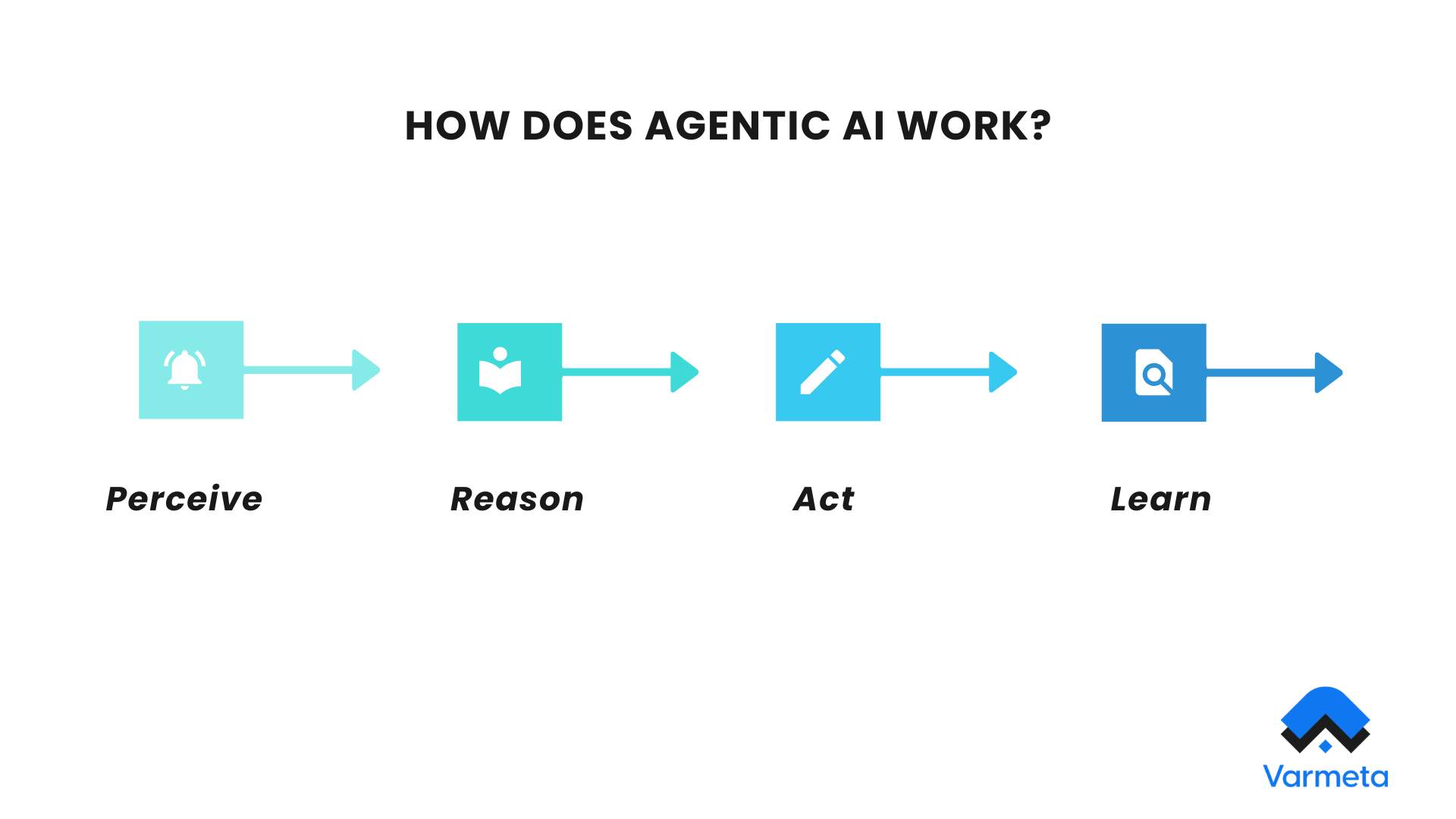
Agentic AI operates through a structured, iterative process that enables it to perceive, reason, act, and learn. This approach allows AI systems to function autonomously and adaptively, tackling complex problems with minimal human intervention.
1. Perceive
Agentic AI begins by gathering and interpreting data from diverse sources, such as sensors, databases, and digital interfaces. During this stage:
- The AI extracts meaningful features from raw data.
- It identifies key elements in its environment, such as objects, patterns, or relevant entities.
- Advanced techniques like image recognition, natural language processing, and data analytics come into play to provide a clear understanding of the context.
2. Reason
At the heart of Agentic AI is its ability to reason and make informed decisions. A reasoning engine, often powered by a large language model, orchestrates this step by:
- Understanding tasks and formulating appropriate solutions.
- Coordinating specialized models for tasks like content creation, image analysis, or personalized recommendations.
- Employing advanced methodologies, such as retrieval-augmented generation (RAG), to access proprietary or external data sources and deliver accurate, context-specific outputs.
This stage mirrors human problem-solving by combining logical processing with data-driven insights.
3. Act
Once a plan is formulated, Agentic AI transitions to execution:
- It integrates seamlessly with external tools, applications, or software via APIs to carry out its tasks.
- Built-in safeguards or “guardrails” ensure the AI performs actions correctly and within predefined boundaries.
For instance, a customer support AI may handle routine queries autonomously but escalate complex issues to a human supervisor when needed.
This capability makes Agentic AI highly adaptable, enabling real-time task execution across a variety of domains.
4. Learn
Agentic AI continuously evolves through a self-improving feedback loop:
- Data from its interactions, often referred to as a “data flywheel,” is collected and analyzed.
- This information feeds back into the AI’s models, refining its performance over time.
- By learning from both successes and failures, Agentic AI becomes increasingly efficient and effective in decision-making and execution.
This dynamic learning ability ensures that Agentic AI not only keeps pace with changing environments but also excels in optimizing operations and driving innovation.
By combining perception, reasoning, action, and learning, Agentic AI mirrors human-like problem-solving while leveraging the speed and scale of automation. Its structured process equips businesses with a powerful tool to enhance decision-making, streamline operations, and achieve transformative results.
The expansive potential of agentic AI: Unlocking possibilities across industries

The applications of Agentic AI are limited only by the creativity and expertise of those who wield it. From simplifying routine operations to solving complex industry challenges, these AI-powered agents are transforming the way businesses operate.
1. Customer service: Redefining interactions
Agentic AI is enhancing customer experiences by automating routine communications and improving self-service capabilities.
- Efficient support: AI agents are reducing response times and boosting satisfaction by resolving common queries without human intervention. Over half of service professionals report that AI tools have significantly enhanced customer interactions.
- Digital humans: A growing trend involves AI-powered, lifelike digital humans that represent a company’s brand. These virtual agents can interact with customers in real-time, handling sales inquiries or addressing issues during peak call volumes. By bridging the gap between automation and personalization, digital humans provide a seamless customer experience.
2. Content creation: Streamlining marketing efforts
Agentic AI has transformed how businesses create and distribute marketing content:
- Time savings: Generative AI agents help marketers produce high-quality, personalized content in minutes, saving up to three hours per piece.
- Increased engagement: By automating repetitive content creation tasks, businesses can focus on innovation and strategy while maintaining a competitive edge. This approach improves customer engagement and helps brands stay relevant in a fast-paced market.
3. Software engineering: Boosting developer productivity
The software development industry is experiencing a significant productivity boost thanks to Agentic AI:
- Automation: AI agents handle repetitive coding tasks, such as debugging, testing, and generating code snippets.
- Future impact: By 2030, it’s estimated that up to 30% of work hours in software development could be automated. This shift allows developers to focus on solving complex problems, fostering innovation, and accelerating project timelines.
4. Healthcare: Empowering better care
Agentic AI is transforming the healthcare landscape, making it more efficient and patient-focused:
- Data-driven insights: AI agents analyze vast amounts of medical data to assist doctors in making informed decisions.
- Administrative automation: Tasks such as capturing clinical notes and scheduling appointments are streamlined, reducing the administrative burden on healthcare professionals.
- Patient support: AI agents offer 24/7 assistance for tasks like medication reminders, appointment scheduling, and answering patient queries. These features ensure patients adhere to treatment plans while enhancing their overall care experience.
5. Video analytics: Transforming visual intelligence
Agentic AI is revolutionizing industries that rely on visual data by leveraging advanced video analytics:
- Visual data processing: AI agents can analyze live or archived video streams from cameras, IoT devices, and vehicles.
- Smart operations: These agents perform tasks like video search, summarization, and visual question-answering, making it easier to extract meaningful insights.
- Industry applications: From drafting incident reports to delivering anomaly alerts and improving quality control, video analytics agents are becoming indispensable. They also play a critical role in predictive maintenance, identifying potential issues before they escalate.
Getting started with agentic AI
Embarking on your Agentic AI journey doesn’t have to be overwhelming. Here’s a simple roadmap to follow:
- Learn the fundamentals: Understand what Agentic AI is, its unique capabilities, and how it’s used in various industries.
- Set clear objectives: Define the problems you want AI to solve or the tasks you aim to automate.
- Find the right tools: Choose AI platforms, SDKs, or APIs that align with your needs and expertise.
- Start with a pilot: Launch a small-scale project to test the AI’s effectiveness and gather insights.
- Partner for expertise: Work with AI specialists if you need additional support for development and deployment.
- Ensure responsible use: Implement safeguards to keep your AI systems ethical, transparent, and secure.
- Refine and expand: Continuously improve your system and scale it to other areas once proven successful.
By following these steps, you can leverage Agentic AI to drive meaningful improvements and innovation in your projects or business.
Conclusion
Agentic AI is redefining what’s possible with artificial intelligence. Its ability to perceive, reason, act, and learn autonomously makes it a transformative tool across industries, from healthcare to customer service, software engineering, and beyond. By automating complex tasks, streamlining operations, and enhancing decision-making, Agentic AI is not just a technological advancement, it’s a leap toward a smarter, more efficient future.
As businesses and individuals embrace this innovative form of AI, the key to success lies in thoughtful implementation, ethical practices, and continuous learning. Whether you’re looking to solve a specific problem or drive large-scale innovation, Agentic AI offers limitless potential to shape the world in new and exciting ways.
The future is here, and Agentic AI is leading the charge. Are you ready to be part of the transformation?