A growing number of subscription apps now start their sales process outside the App Store. A person sees an ad, answers a short quiz on a web page, reaches a paywall, pays by card or wallet and only then receives a link to download the app. This route is usually called a web2app funnel, or a web to app funnel, and it has moved from a niche tactic to a standard option for teams that run paid acquisition. The shift is driven by money and by control: the store takes a commission on every in-app subscription, while a web checkout lets the publisher set the price, keep more of each payment and see where users come from.
This article explains what a web2app funnel is, why subscription apps adopt it, where Apple’s rules stand in the United States and Japan, what the available numbers show, which risks come with it and when it makes sense to try one. It is written for product managers, founders and growth marketers who run an app subscription business.
What a Web2App Funnel Means
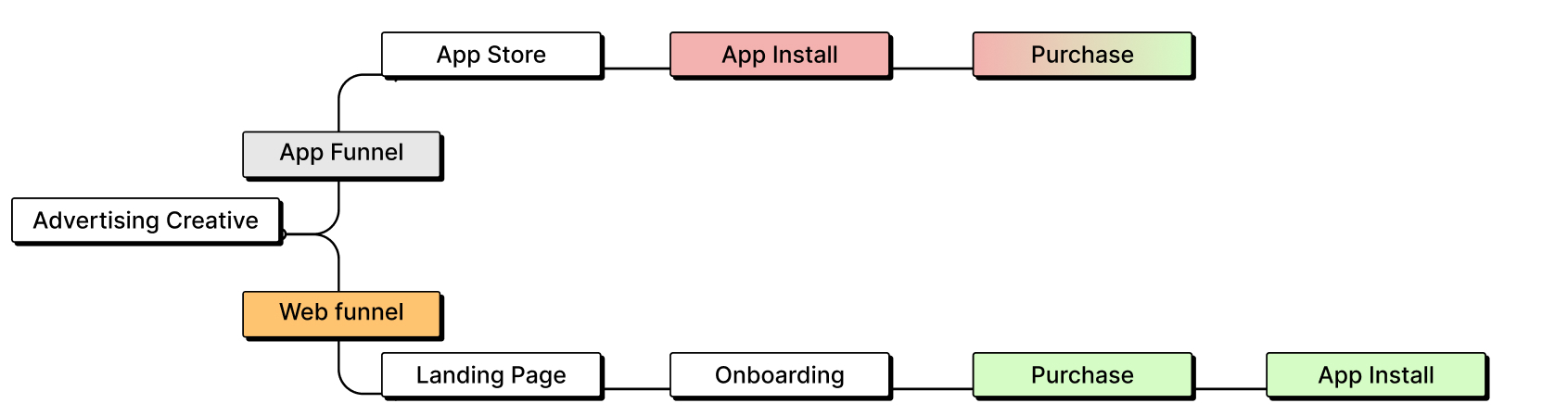
In a web2app funnel, the user’s first contact with the product happens on the web. RevenueCat’s guide to web-to-app funnels describes the idea in one sentence: web funnels transition users from a web experience into an app, with payment happening in either environment. A typical web funnel for mobile apps has three parts. A quiz or short questionnaire collects goals and builds interest, a paywall presents the plan and price, and a checkout takes payment. After payment, a deep link or a login step opens the app already connected to the new subscription.
The term is easy to misread. A web2app funnel does not convert an app into a website or a progressive web app. The product is still a native app that the user installs. What changes is the place where the user decides and pays, which moves from the store listing to a page the publisher controls.
Why Subscription Apps Are Moving Toward the Web
Three reasons come up most often. The first is the fee. Apple’s Small Business Program lowers the commission to 15 percent for developers with up to 1 million USD in proceeds in the prior calendar year, and the standard rate for in-app purchases has been 30 percent, a figure the Ninth Circuit’s December 2025 opinion in Epic v. Apple repeats. A payment taken on the web avoids that commission, although it brings processor fees and other costs that the sections below discuss.
The second reason is control over the offer. RevenueCat’s guide points out that a web funnel gives a publisher more space to make its case than an app store listing does, and that a team can keep improving the page from data without waiting for App Store review. Prices, trial lengths and quiz questions can be tested quickly and matched to the promise of a specific ad.
The third reason is data: a quiz and checkout on a page the publisher owns leave behind answers, an email address and a record of the ad that brought the person, which supports attribution.
The adoption data points the same way. RevenueCat’s State of Subscription Apps report for 2026, covering more than 115,000 apps and 16 billion USD in revenue, found that web revenue made up 3.2 percent of total subscription revenue globally, 4.9 percent in North America and 0.8 percent in India and Southeast Asia. Forty-one percent of the top-performing apps in its highest revenue tier generated some web revenue, compared with 1.3 percent in its lowest tier.
RevenueCat’s analyst estimated that about two-thirds of web revenue comes from the United States. These figures come from a vendor that sells web funnel tools, and the page reports no web-specific conversion or retention numbers, so they show how common the practice is and say little about how well it performs.
What Apple’s Rules Say in the United States and Japan
The legal position matters because it sets the cost of sending users from an app to a web checkout. The rules differ by country, and in the United States they are still in motion.
In the United States, a district court order of 30 April 2025 found Apple in contempt of an earlier injunction and barred it from charging any commission on purchases made outside the app, among other restrictions. Before that order Apple had charged 27 percent on purchases made through external links within seven days of the click, a rate the Ninth Circuit agreed was prohibitive. On 11 December 2025 the Ninth Circuit upheld the contempt finding and also held the blanket ban on commissions to be overbroad. Apple may charge a commission linked to costs that are genuinely and reasonably necessary, the court said, and the district court must set what that is.
The case has continued since then. According to MacDailyNews, Justice Kagan denied Apple’s request for a stay on 13 August 2026, so the lower court can proceed with setting a permissible rate while the Supreme Court considers the contempt finding in its term beginning in October. The same report says Apple has charged zero commission on US link-out purchases since the contempt ruling, and that Apple has proposed 15 percent for standard apps, 10 percent for certain partner programs and subscription renewals, and 5 percent for Small Business Program apps. Those figures are proposals, and Epic has said it will contest them.
Japan has a settled framework. According to coverage of Apple’s 17 December 2025 announcement, developers there can link users to websites to complete transactions, and Apple applies a 15 percent Store Services Commission on digital goods and services purchased that way, reduced to 10 percent for qualifying developers and for subscriptions after their first year. Apple also stated it cannot issue refunds for purchases made through alternative payments or website links. Apple’s Small Business Program page mentions separate alternative terms in the EU, which this article does not cover.
| Market | Fee on linked-out digital purchases | Status |
| United States | 0 percent at present | Court-ordered; Apple has proposed 15, 10 or 5 percent depending on the app, and the amount is still to be decided |
| Japan | 15 percent, or 10 percent for qualifying developers and for subscriptions after the first year | Announced by Apple on 17 December 2025 |
The practical reading is that the US zero-fee position is real today and may not last. A team that builds its economics on a zero commission is making an assumption that the court could change.
How a Web2App Funnel Works Step by Step
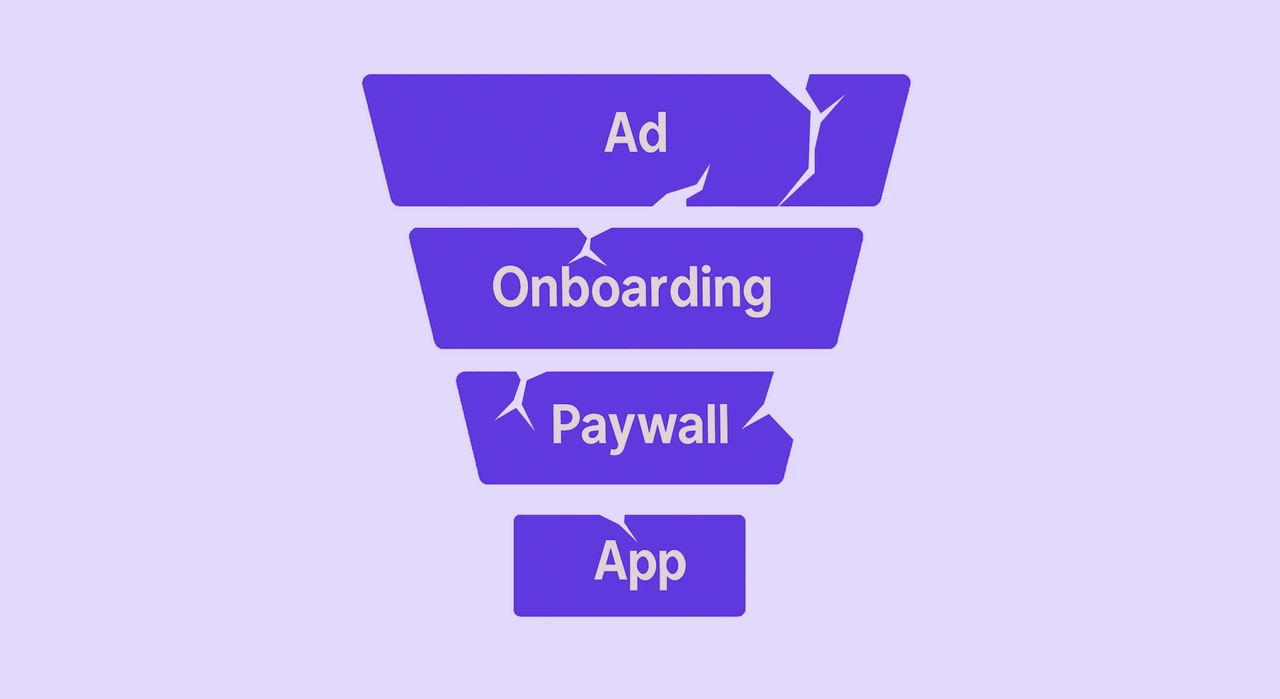
A funnel is a chain, and each link has a job. The table sets out the usual sequence and the main question to answer at each stage.
| Stage | What happens | What to check |
| Ad or post | A campaign promise brings the person to the web page | Does the page repeat the promise of the ad? |
| Quiz | The person answers questions about goals or preferences | Do the answers shape the offer, or only lengthen the path? |
| Paywall | A plan and price are shown, often with a trial or discount | Which price and trial length convert best? |
| Checkout | Card or wallet payment is taken | How many people start checkout and fail to finish? |
| App handoff | A deep link or login opens the app with the subscription active | Does the account match across web and app without extra steps? |
RevenueCat’s guide stresses that the whole chain has to work as one journey: the ad, funnel, checkout, tracking, customer identity and app handoff each affect the result, and a break in any of them lowers it. Its recommended order of work is to define the campaign promise, choose a template for the target audience, set success metrics, test the whole journey from start to finish, launch small and use the results to choose the next experiment.
The handoff is where many funnels leak, since a person who has already paid expects the app to recognize them without a second registration.
Risks That Come With Moving Payment to the Web
A lower commission can still come with a higher total cost, because several risks sit on the other side of the ledger.
Payments and refunds move to the publisher. The Japan rules state that Apple will not issue refunds for purchases made through website links, so refunds, chargebacks and failed payments fall on the publisher’s own systems and support team. Taxes need a plan too, because a store collects and remits sales tax or VAT in many markets, while a publisher selling directly must handle it or use a payment provider that does. Payment processors charge their own fees, which vary by provider and country and should be checked on the provider’s pricing page before any comparison with the store commission.
Discovery is a second risk. A person who finds the app through store search never sees the web funnel, so a team that shifts its energy to paid web campaigns can neglect the store page that still converts organic visitors. The earlier article on app store product page optimization covers that part of the journey.
Measurement is a third. RevenueCat notes that tracking and measurement differ depending on whether a mobile measurement partner is used, and that influencer and affiliate campaigns carry their own tracking and disclosure rules. A web2app funnel can improve attribution when it is set up carefully, and it can fragment attribution when web and app data are not joined by a shared customer identity.
When a Web2App Funnel Makes Sense and When It Does Not
The fee comparison shows where the gain is largest. The table uses 100 USD of subscription revenue as an illustration and ignores processor fees, taxes and refunds.
| Route | Commission on 100 USD | Revenue kept before other costs |
| In-app purchase, standard rate | 30 USD | 70 USD |
| In-app purchase, Small Business Program | 15 USD | 85 USD |
| US web checkout via link-out, current order | 0 USD | 100 USD |
| US web checkout, if Apple’s 15 percent proposal were adopted | 15 USD | 85 USD |
| Japan web checkout via link-out | 15 USD (10 USD for qualifying cases) | 85 USD (90 USD) |
For apps inside the Small Business Program the saving is smaller than for apps paying the standard rate, and under Apple’s proposed US rates it could disappear. For apps above the 1 million USD threshold that spend heavily on paid acquisition, the gap is larger and a web funnel is more likely to cover its own running costs.
The model also suits some products better than others. A quiz that personalizes the offer works well for fitness, language learning, wellness and similar categories where the user’s goal shapes the plan. A utility app with a one-tap value proposition has less to gain from a long quiz, and an app whose users mainly arrive through store search may see little benefit. Teams with no capacity to handle payments support, tax and attribution should weigh that workload before they start.
How to Begin With a Small Test
A first test does not need to replace the in-app paywall. A sensible start is one market, one campaign and one funnel, run alongside the existing store flow so the results can be compared. RevenueCat’s own sequence of defining metrics, testing the complete journey and launching small applies here. The metrics worth fixing before launch are the share of visitors who finish the quiz, the share who start and complete checkout, the share of buyers who open the app and finish setup, and the revenue per visitor compared with the store route.
Because a fee change would alter the comparison, a test that looks profitable at a zero commission should also be read at 15 percent.
Building a Web2App Funnel With Varmeta
A web2app funnel joins several pieces that are usually built by different people: the landing and quiz pages, the paywall, payment and subscription logic, and the app that receives the new user. At Varmeta we build digital products across many industries, and our portfolio covers both web and mobile work.
We are also building and testing web funnels alongside our own app products, which keeps us close to the practical questions covered above, such as how to hand a paying user into the app and how to read the results of a first test. Teams that are considering a web funnel for an app subscription can talk through scope, the handoff into the app and measurement with us through our contact page.
Conclusion
A web2app funnel moves the decision to pay from the store listing to a page the publisher controls, and the reasons are fees, control of the offer and better data. The adoption figures show that the practice is established among larger apps, with 41 percent of the top revenue tier reporting some web revenue, while web revenue remains a small share of the total at 3.2 percent globally.
The rules are less settled than the enthusiasm suggests. The US zero-commission position comes from a court order that is under review, Apple has proposed rates of up to 15 percent, and Japan already applies a 15 percent commission to linked-out purchases. A team that runs a web2app funnel as a measured test, with the fee position checked in each market and the handoff into the app tested end to end, gets the benefits of the model without building the business on an assumption that may change.